

Three years ago, before a two week trip to Italy, I bought the HERO Travel Supply neck wallet for one stubborn reason. I wanted both passports on my body instead of in a bag that could be set down on a chair and forgotten. I have worn it on every international trip since. I have worn it through airport security in Madison, on trains in Portugal, and across more hotel lobbies than I could count if I tried. This is not a review written after a weekend. It is what I would tell a client who asked me point blank whether the thing is worth the trouble, including the parts that are genuinely a nuisance.
Most write ups on this wallet spend their words on the RFID lining. The lining is real and I will get to it. But the questions people actually ask me are duller and more useful. Does it make your neck sweat? Does the strap show under a shirt? Will two passports and a backup card fit without the zipper straining? Does wearing it make you feel like you are advertising something? Here is what three years of real use has taught me about the HERO Travel Supply wallet, and the point at which it stops being the right answer for a traveler.
The Quick Verdict
A quiet, well built passport pouch that holds two passports flat against your chest and disappears under a cotton shirt. It is not invisible, it is not cool in August, and the strap takes about a week to learn.
Amazon Check Today's Price →Wear it once on a travel day and you stop worrying about the bag on the chair
Mine has carried two passports, a backup card and local cash on every trip since Italy. Flat, light, and zipped shut against your chest. Check the listing for today's price and the strap adjustment.
Amazon Check Today's Price on Amazon →How I've Actually Used It
The wallet goes on under my shirt on travel days. Airport, train station, the walk from the station to the hotel with luggage in tow. On those days it holds my passport, Walt's passport, one backup credit card, and whatever local currency I picked up at the airport. In the evening, or on an ordinary day of sightseeing, it stays in the room and my day money goes in a small plain zip purse in my handbag. That split matters and I will come back to it, because it is the difference between this wallet being useful and this wallet being a habit that stops paying for itself.
Walt does not wear one. He keeps his passport in the inside pocket of the bag he carries, and that is a choice rather than a mistake. It works for him. But it means that on travel days I am the one holding both documents, which is exactly how capacity stopped being a nice extra for me and became the main question I needed answered.
Three years in, the zippers still run clean. The strap has not frayed. The fabric has not gone shiny at the corners where it rubs against a collarbone. I am not gentle with it. It gets stuffed into the outside pocket of a carry-on while I go through security, then pulled out and put back on. Nothing has torn, nothing has separated, and nothing has worked its way out of a compartment.
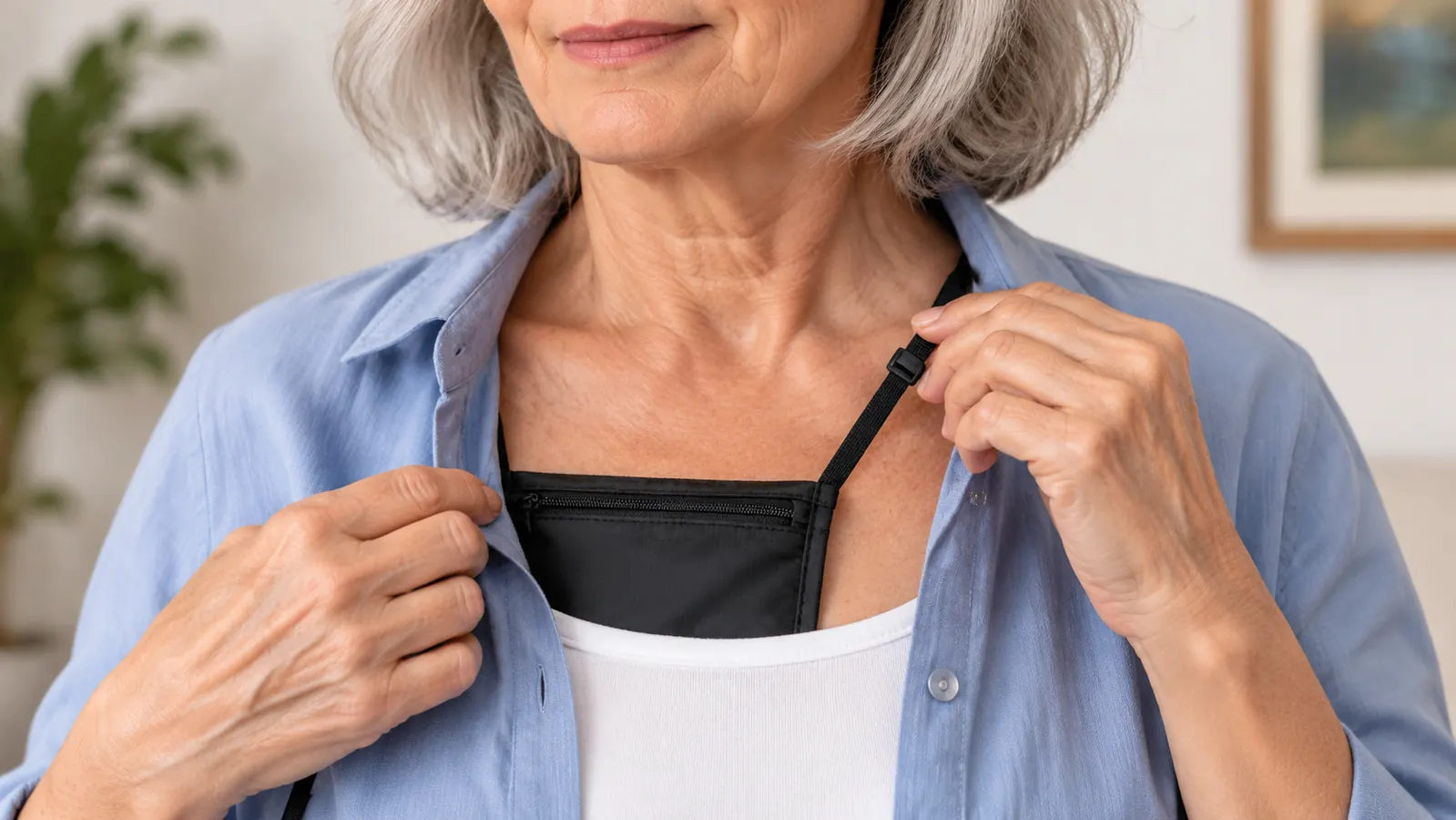
What Nobody Tells You About Wearing It Under a Shirt
The honest answer to the sweat question is yes, a little. The pouch is nylon, and nylon against bare skin in August in Rome is not a pleasant combination by mid afternoon. On days when I knew we would be walking for hours in heat, I wore it over a thin undershirt instead of directly against skin, and that solved nearly all of it. Two ounces and a flat profile help. It is not hot the way a money belt around the waist is hot. It is a small warm patch at the sternum, and after an hour you stop noticing it is there at all.
The strap takes about a week to learn. It is adjustable, and the setting that feels right while you are standing in a hotel room is not the setting that feels right after four hours of walking, because the wallet rides up as you go. Once I found my length I stopped fiddling with it. That first week, though, I was reaching under my collar constantly to tug it back down, which is the opposite of what you want to be doing in a crowded place.
Under a shirt it is close to invisible. Under a thin summer blouse, in good light, a careful person can see the outline of something flat at chest height. Nobody has ever said a word to me about it, and I have stood in plenty of lines where somebody would have. I would not wear it under a sheer top and call it concealed. I would wear it under a cotton shirt or a light sweater and forget I had it on.
Two passports, a backup card and a fold of local cash fit into 8 inches by 5.5 inches, and I wore it under a cotton shirt for eleven hours without adjusting it once.
Capacity: What Actually Fits
The wallet measures 8 inches tall, 5.5 inches wide and 0.2 inches deep, and weighs 2.3 ounces. That is a passport sized pouch, which sounds obvious until you try to put two passports into something designed around one. Two fit. They sit side by side in the two sections, and the zip closes over both without strain. That single sentence is why I bought it and why I still use it.
There are five compartments and two sections. In practice I use three of them: one passport sleeve, the second passport sleeve, and the zip pocket for the backup card and the cash. The remaining compartments take tickets, or a card you want kept separate from the rest. On the days I still print a boarding pass, which is most of them, it goes flat in the front and comes out without disturbing anything else.
The 0.2 inch depth is the number worth thinking about. This is a flat pouch and it wants to stay flat. If you fill all five compartments, it thickens into something that sits away from your chest and shows under a shirt. My rule is two passports, one card, paper money. The listing notes that a large phone fits without a bulky case, and it does, but with two passports already in there the outline becomes obvious, so the phone stays in my pocket. Pack it flat and it stays discreet. Stuff it and it stops being discreet.
The RFID Lining, the Zippers and the Rest of the Build
The RFID lining is the feature the listing leads with, and it is genuinely there. Multiple layers shield cards and passports from being read at a distance. I will be straight with you about how much that matters. Close range card skimming is rare, and in twenty six years of booking travel I have never had a client tell me a first hand story of it happening to them. It is a nice thing to have and it costs you nothing in weight. It is not the reason to buy this.
The build is the reason. Ripstop nylon, YKK zippers, and a zip that runs one handed, which matters more than it sounds when you are in a security line trying to get a passport away quickly. HERO Travel Supply says each wallet is individually tested in the USA before it ships, and they offer a lifetime replacement guarantee. I cannot verify the testing. I can tell you that mine has three years of use on it and shows no sign of failing.
It is water resistant, not waterproof. A spilled bottle of water in a tote bag beads up on the outside and wipes off. I would not swim with it and I would not leave it out in a downpour. The fabric has stayed supple, the edges have not curled, and the only visible wear is a slight softening along the fold where it bends against my chest.
What I Liked
- Two passports sit side by side and the zip closes over both without strain
- Disappears under a cotton shirt or a light sweater
- 2.3 ounces and flat enough that you forget it is on after an hour
- Zippers still run smoothly after three years of travel days
- Adjustable strap holds its setting once you find the right length
Where It Falls Short
- Nylon against bare skin gets warm on hot days
- The 0.2 inch depth means it only stays discreet if you pack it flat
- The strap takes about a week to learn
- Two passports plus a phone plus a wallet will bulge
- The RFID lining is a small bonus, not a reason to buy on its own
Security Lines and Hotel Rooms
Airport security is where a neck wallet earns or loses its place in your kit. Mine comes off with my shoes and goes in the tray on top of my jacket, then goes straight back on the other side, before I pick up anything else. Because it never goes into the bin loose, there is no moment where a passport is sitting in a plastic tray among three other people's laptops. That is a small procedural thing and it is the most practical argument for this wallet that I can give you.
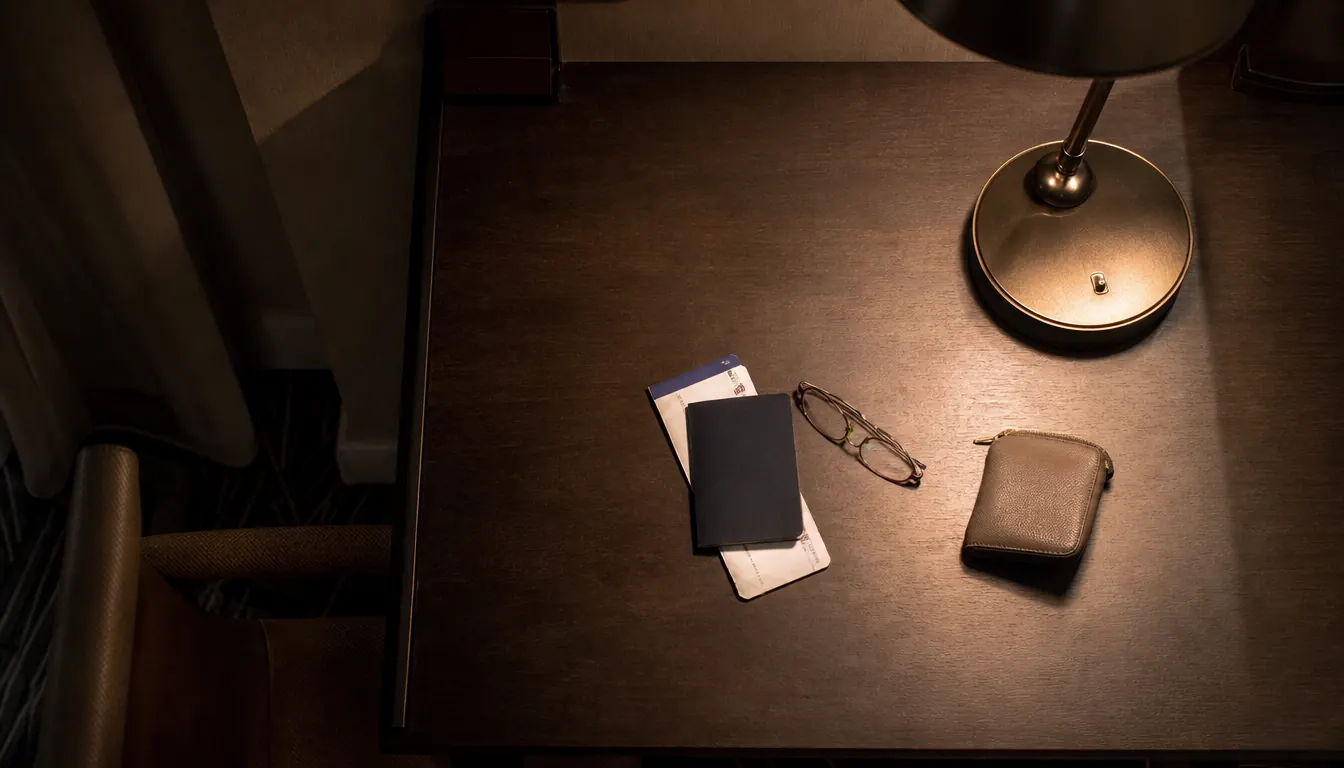
In hotel rooms it lives in the same place every night. The flat pouch goes into the inside zip pocket of my carry-on, closed, with both passports still inside it. My day purse goes on the desk. That habit is worth more than any single piece of gear, honestly. The wallet just makes the habit easy to keep, because the documents are already grouped in one flat object that either goes in the bag or goes on my body. There is no sorting to do at the end of a long day.
How It Compares to What I Did Not Buy
I have never owned an anti-theft crossbody bag, so I will not pretend to review one from experience. What I can tell you is why I did not go that route, and why clients who ask me usually end up choosing between the two. A crossbody carries more, sits in front of you where you can see it, and does not put nylon against your skin. It also hangs on your body all day, which some travelers find tiring by the afternoon, and it changes how you are dressed in a way a hidden pouch does not. If you want one bag that holds everything, that is your answer.
The neck wallet is the narrower tool. It holds documents and money, nothing else, and it lets you carry an ordinary handbag or nothing at all while your passport stays against your chest. I chose the narrower tool because I wanted the least amount of gear possible and I wanted my hands free. If you are deciding between the two, the real question is whether you want one bag for everything or one small thing that never leaves your body. I have written more about that comparison separately if you want the longer version.
What I Would Change
Two things. First, the strap. A slightly wider, softer band at the back of the neck would make a long day more comfortable and would cost almost nothing in weight. Second, I would like a second small zip pocket on the front panel, so a single card could come out without opening the main compartment in public. Neither of those is a reason to avoid the wallet. Both are the kind of small refinement that only becomes obvious after you have used a thing for three years.
And one honest limitation that is not a design flaw. This is not a replacement for a handbag. It holds documents and money. It does not hold your glasses, a tissue, a pen, or the paper map you picked up at the tourist office. In practice I carry both, and the neck wallet is the piece that never leaves my body while everything else moves around it.
Who This Is For
Travelers who want their documents on their body without changing anything else about how they dress. If you fly internationally once or twice a year and you are the person in your household who handles both passports, this is the most sensible version of that job I have found. It is also good for anyone who has started to feel uneasy about a bag hanging on the back of a restaurant chair. Older travelers tend to take to it in particular, because it removes a decision you would otherwise have to make every time you stand up.
It suits people who pack light and flat. Two passports, one card, paper money, zipped shut. If that is your travel kit, the HERO Travel Supply wallet is built around exactly that shape and nothing more.
Who Should Skip It
Skip it if you run hot. If you are the person who is damp by the second hour of a summer day, a nylon pouch against your sternum is going to bother you, and no amount of strap adjusting will fix that. Skip it too if you need one bag for everything, because this is a document pouch, not a purse, and asking it to be both will leave you disappointed in a way the product does not deserve.
Skip it if you want to reach for a card without undoing a button. Every retrieval is a small private maneuver, which is rather the point, but it is also friction, and some travelers hate friction more than they fear a crowded train. And if you travel with a partner who reliably carries the documents and you are content with that arrangement, you do not need this. Walt does not have one. He is fine.
The one piece of gear that never leaves my body on a travel day
Three years, two passports, and no failures. If your travel kit is documents on your chest and everything else in a bag, this is the flat, light version of that idea. Check the listing for today's price.
Amazon Check Today's Price on Amazon →