
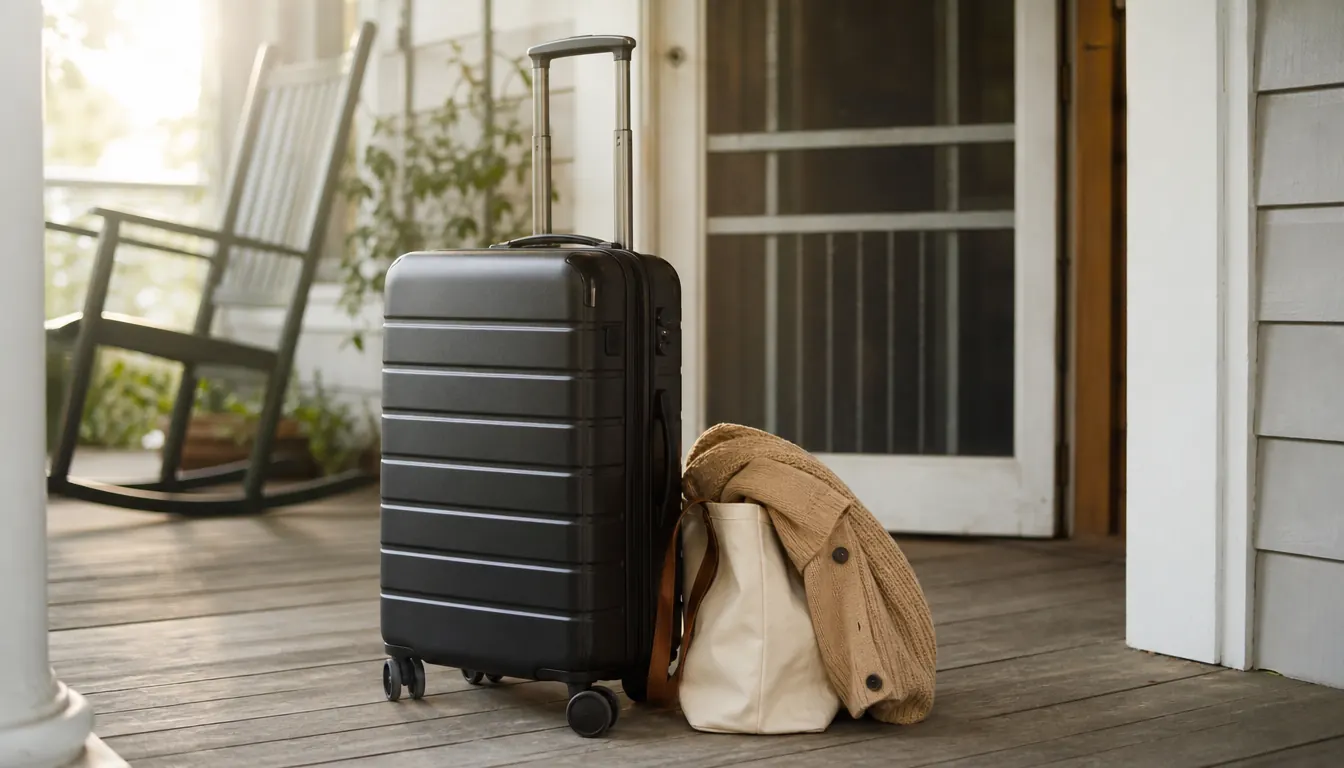
The bag I carried before this one had two wheels and a soft fabric body, and I bought it in 2009. It served me well for over a decade. Then, on the way to the airport one morning, the plastic housing around the wheel cracked straight through and the bag started dragging at an angle like a shopping cart with a bad caster. I stood in the driveway and made a decision I should have made a year earlier.
I replaced it with the Samsonite Omni PC Hardside Carry-On, the 20-inch spinner, about two years ago, a few weeks before a spring trip to Portugal. It has been on roughly eight trips since, some of them nine days long. It is my bag and only my bag. Walt still uses his own older softside roller, which means our hallway on packing night looks like a before-and-after photo for a luggage commercial. Here is what two years of actual use has taught me about the Samsonite Omni, including the parts that are not flattering.
The Quick Verdict
A light, scratch-resistant spinner that rolls beautifully through an airport and packs more than it looks like it should. The expansion gusset is the one feature I use least and the shell does scuff, but after eight trips nothing has broken.
Amazon Check Today's Price →The 20-inch hardside spinner I've taken on eight trips and never once checked
It meets most domestic carry-on restrictions, weighs 6.1 pounds empty, and comes with a 10-year warranty against defects in materials and workmanship. See today's price and the current rating on Amazon.
Amazon Check Today's Price on Amazon →How I've Used It
I want to be clear about the kind of traveler I am, because it shapes everything below. I am 63. I run a travel agency out of a ranch house outside Madison, Wisconsin, and after 26 years in this business I am part-time now. Walt and I take about four trips a year. One or two are international, usually Europe, and the rest are domestic. On short domestic trips of two or three nights, we share the Samsonite and he leaves his own bag at home. On longer trips, we each bring a carry-on and we check nothing.
That last part matters more than it used to. Checking a bag means standing at a carousel at the end of a long day, and neither of us is interested in that anymore. So this bag has to hold nine days of clothing for a woman in her sixties who does not want to do laundry in a hotel sink. It does, but only because I pack it deliberately, and I will show you how below.
The bag itself is a hard polycarbonate shell with a micro-diamond texture on all faces, four spinner wheels, a telescopic handle, and a TSA lock. The listed packing dimensions are 19 by 14.5 by 9.5 inches, and the overall dimensions including wheels and handle come to 22 by 15 by 9.5 inches. Empty weight is 6.1 pounds. I read the label and the fine print on this one before I bought it, the way I read the fine print on a hotel contract, because an inch too many is the difference between walking onto the plane and paying to check at the gate.
I tested that, by the way. I measured it against the metal sizer beside the gate in Madison once, out of plain curiosity, with the expansion zipped shut. It slid in with an inch of room at the top and room on both sides. That sizer is the thing I actually care about, more than any chart on a product page, because the sizer is what stands between you and a fee on a bad morning.
The Shell, the Scuffs, and What Two Years Did to It
The first thing anyone notices about a hardside bag is whether it will look like a museum piece after one trip. Mine does not. There are pale scuff marks along the lower corners and one faint scratch near the top edge where the bag rode against a shuttle van door. That is what two years and eight trips look like. What has not happened is a crack, a dent, or a hinge that gave way, and I have watched baggage handlers at O'Hare load a regional jet with the same gentle care they give a sack of potatoes.
The worst of the marks came from a shuttle van in Milwaukee last March. The driver stacked my case at the bottom of a pile and then slid something heavier on top of it, and I heard the plastic scrape against a metal rail as we pulled away from the curb. I got the bag back with a fresh white streak along the bottom corner. By midsummer I could not find that streak without turning the case toward the window light, which tells you more about the texture than any description I could write.
The polycarbonate texture does most of the work here. It is not a smooth, glossy finish that shows every fingerprint and abrasion. It has a fine raised diamond pattern that breaks up light and hides small damage. I would still not call it indestructible, because nothing in a cargo hold is, but it takes a hit better than the softside bag it replaced ever did.
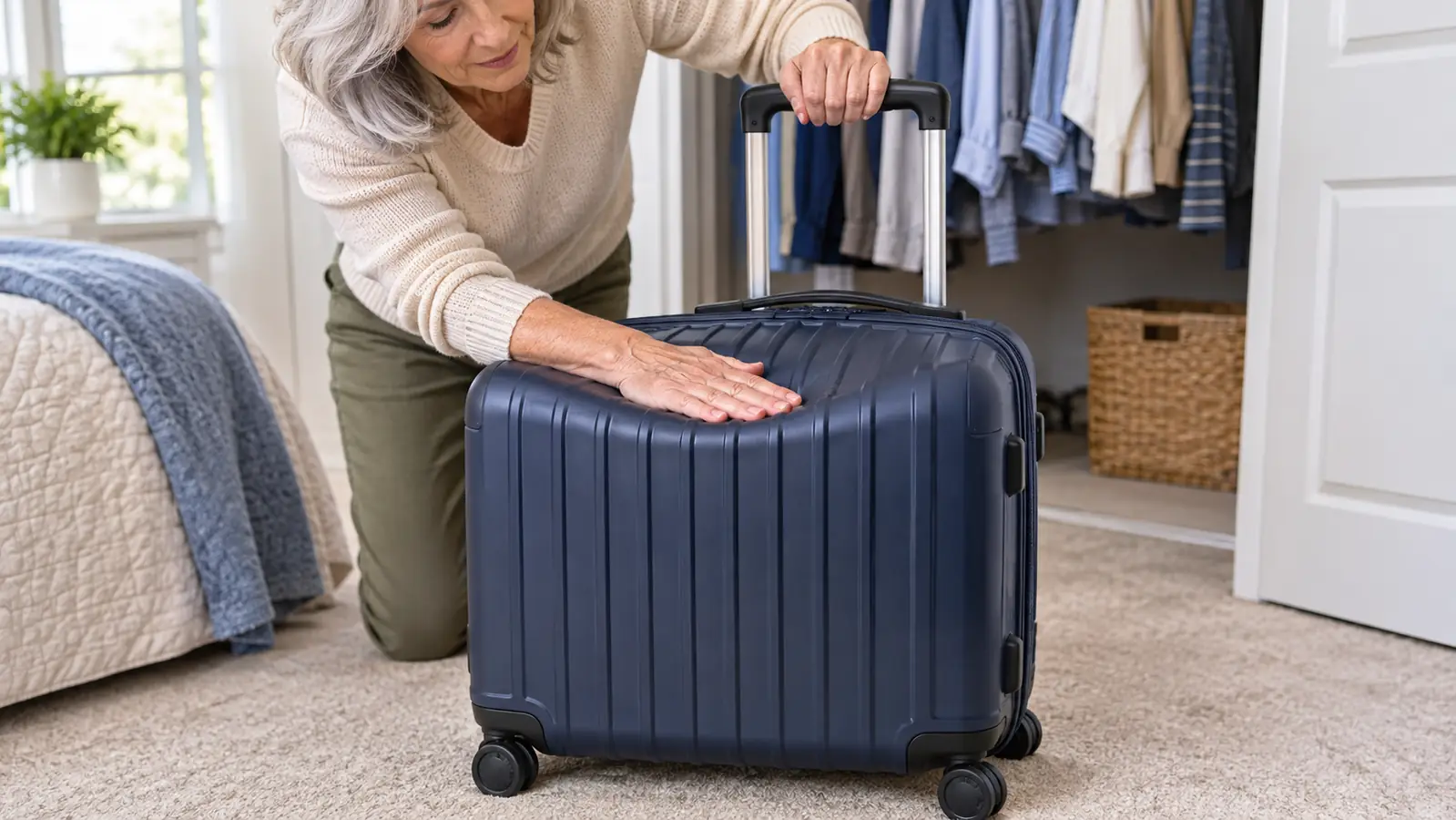
The shell does flex. If you press down hard on the top edge, you can feel it give, and on a full bag the flex is noticeable when it is stacked under something heavier. That is not a defect. It is how polycarbonate is supposed to behave, and it is a large part of the reason the bag weighs 6.1 pounds instead of eight. If you want a case that feels like a bank vault door, you will pay for that rigidity in weight you then have to lift into an overhead bin.
What has not happened is a crack, a dent, or a hinge that gave way, and I have watched baggage handlers at O'Hare load a regional jet with the same gentle care they give a sack of potatoes.
Two Sections, One Expansion Gusset, and the Packing Math
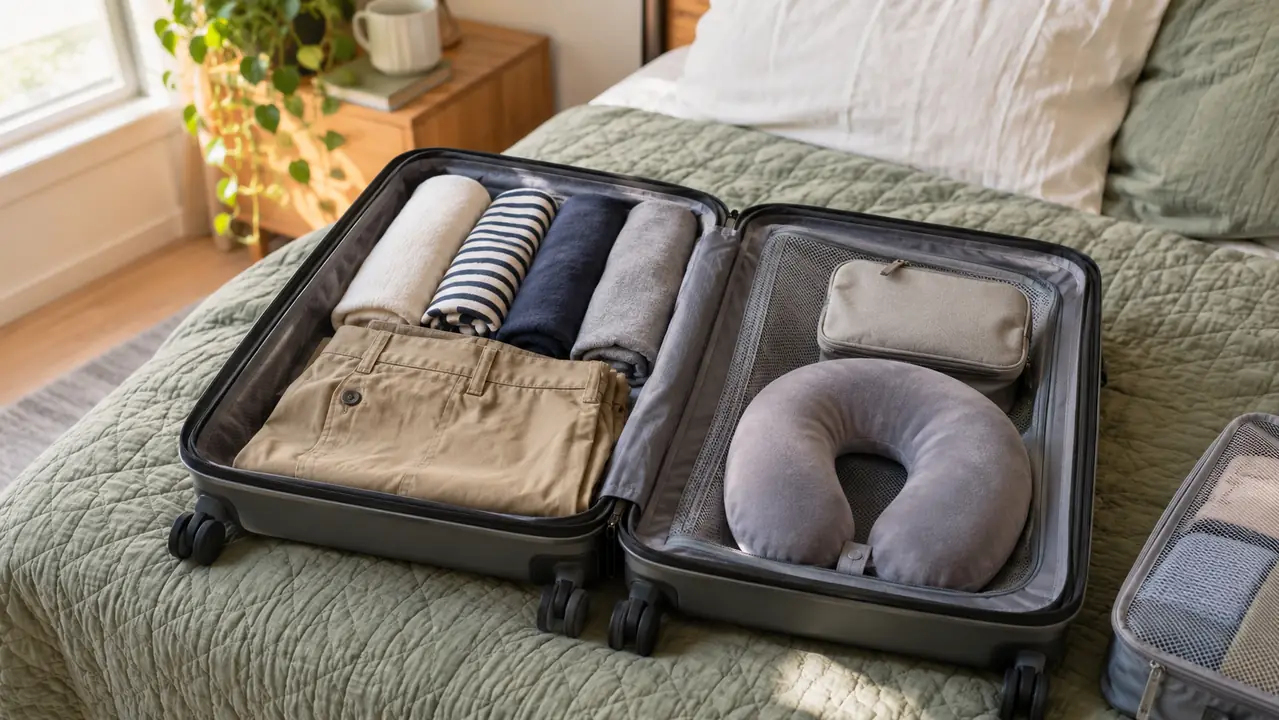
The interior is two sections, split by a zippered divider. On my side of the divider, I use the compression straps and stack rolled clothing. On the other, which is fully lined and closed, I put anything I want to stay put: a small pouch, a folded cardigan, and the neck pillow I bought before the flight to Ireland. The divider is the detail that made me stop resenting hardside bags. You can open this case in a hotel room, on a bed, and nothing falls out onto the floor.
There is also a large expansion gusset. I want to be honest about it, because it is the feature the listing leads with and in two years I have used it exactly twice. Opening that zipper buys you real volume, maybe another inch and a half of depth, and it is genuinely useful on the way home when you have bought a cookbook or two in Lisbon. What nobody tells you is what it does to the bag's footprint. A fully expanded 20-inch case is a wider thing to roll down an airplane aisle, and I have had to turn sideways with it. It also makes the case slightly less stable when it is standing empty. My advice: leave it zipped until the last morning, then decide.
The second time I opened it was the morning we flew home from Ireland. I had bought two wool sweaters, a tin of tea and a mug I had no business buying, and I needed every inch I could get. It closed fine and it rolled fine. What I had not thought through was the bin on the regional jet, which is shallow, and I ended up turning the bag on its side and working it in while the flight attendant waited with the patience of a woman who has watched a thousand people do exactly this. Nobody said a word. I felt every second of it.
For nine days in Portugal, my packing list was five rolled tops, two pairs of trousers, one cardigan, a small toiletry bag, a folder of travel documents, and a pair of walking shoes wedged along the bottom. That fit with room to spare. I used packing cubes for the first time on that trip, bought the same week, and they are the reason the rolled clothes stayed compressed instead of turning into a pile. The bag did not do that for me. The cubes did.
Wheels, Handle, and Getting Through an Airport
Four spinner wheels change how you travel, and I do not think that is an exaggeration. The old two-wheel bag had to be tilted and dragged, which meant a constant pull on my shoulder and wrist. With four wheels, the Samsonite Omni rolls alongside me with two fingers on the telescopic handle, and in a long terminal it is the difference between arriving at the gate tired and arriving at the gate sore. The wheels are the slotted design, set flush into the corner, and they have not wobbled or gotten a flat spot after eight trips.
Charlotte is my test. The concourse there is long, the moving walkways are down as often as they are running, and the floor changes from tile to carpet and back again three or four times before you reach the far gates. On a tight connection last fall I went from one end to the other in about eleven minutes with this bag on the floor beside me and a tote on my shoulder. I would not have tried that with the old two-wheeler. I certainly would not have made it.
The telescopic handle extends with a firm click and has a small amount of play side to side, which is normal for this class of bag and worth knowing if you are expecting a cast-iron feel. My husband's older roller has a tighter handle and a much worse wheel. I would take the loose handle every time.
One thing I do appreciate as I get older: pushing this bag is a two-handed job on carpet and a one-handed job on hard floors. I have walked the length of a terminal with a cup of coffee in my other hand and no trouble. That sounds small. At 63, with a connecting flight in Charlotte, it is not small.
The TSA Lock and the Safety Question
The bag has a TSA lock built into the shell, which means security can open it without cutting anything, and I use it every time I check a bag, which is to say almost never. It closes with a satisfying snap and the zipper pulls tuck into it cleanly.
I want to be measured here, because I have sat with clients who were frightened after hearing one story from a friend of a friend, and fear is not a packing strategy. Nothing has ever been taken from me or from Walt. What I will say is that a lock on a suitcase does one job: it stops an opportunistic hand from unzipping your bag while it sits on a carousel or in a hotel lobby. It does not stop a determined thief, and neither does any lock on any bag. I still lock mine, and I still carry my passport and backup card in a neck wallet under my top on travel days. Those two habits, not the lock, are what let me sleep on a long flight.
What I Liked
- Rolls easily on four spinner wheels with two fingers, which matters more every year I get older
- Micro-diamond polycarbonate shell has taken scuffs but no cracks, dents or hinge failures in about eight trips
- Two interior sections with a full zippered divider, so nothing spills onto the hotel bed
- Light at 6.1 pounds empty, which leaves more of your carry-on allowance for actual clothing
- Listed packing dimensions of 19 by 14.5 by 9.5 inches meet most domestic carry-on restrictions
- 10-year warranty against defects in materials and workmanship
Where It Falls Short
- It will scuff. Mine has pale marks on the lower corners after two years, and no hardside bag escapes this
- The expansion gusset is used twice in two years and makes the bag wider in an airplane aisle
- The telescopic handle has noticeable side-to-side play
- Polycarbonate flexes under pressure when stacked, which is normal but takes getting used to
- A hardside shell gives you no outside pocket for the things you want to reach at the gate
Who This Is For
This bag is for the traveler who wants one carry-on, wants to stop checking luggage, and wants to still be able to lift the thing into an overhead bin without asking a stranger. At 6.1 pounds empty, the Samsonite Omni leaves you room to fill it and still come in under the weight limits some international carriers enforce, which is not true of the heavier hardside cases I have handled for clients.
It is also a good fit if you travel with a partner and share a bag on short trips. Walt and I do this on two and three night domestic trips, and one 20-inch case holds both of us when we are only packing for a long weekend. And it is a good fit for anyone who has gotten tired of dragging a tilted two-wheel bag through a terminal. If your shoulder or wrist has opinions about luggage, the four spinner wheels alone justify the change.
If you are comparing it against a softside bag, I have written a full side-by-side on that, because Walt still carries his old softside roller and the differences are clearer in the house than they are on a product page.
Who Should Skip It
Skip it if you want an outside pocket. A hardside shell has none, which means your book, your boarding pass and your snack all live inside, and every time you need one you are opening the bag in a boarding queue. I solve this with a tote, but I want you to know the tradeoff before you buy.
Skip it if you are a hard packer who sits on the case to close it. The polycarbonate will flex, and while it has held up fine for me, a bag that gets stuffed past its zipper every trip is a bag that ages faster. Skip it, too, if visible scuffs will bother you. I have made my peace with mine. Not everyone wants to, and there is no shame in preferring a fabric bag that hides wear.
And skip a 20-inch case entirely if you are packing for two weeks in a cold climate. That is not a knock on this bag. It is arithmetic. For that trip you need a larger case, and you should plan to check it. I have watched clients talk themselves into a carry-on for a 14-day trip in November and regret it by day four.
Two years in, nothing has broken. If you're ready to stop checking a bag, start here
Four spinner wheels, a scratch-resistant polycarbonate shell, two packing sections and a TSA lock. 6.1 pounds empty, 10-year warranty against defects. I have not had to use the warranty, and I like knowing it is there.
Amazon See the Samsonite Omni on Amazon →