
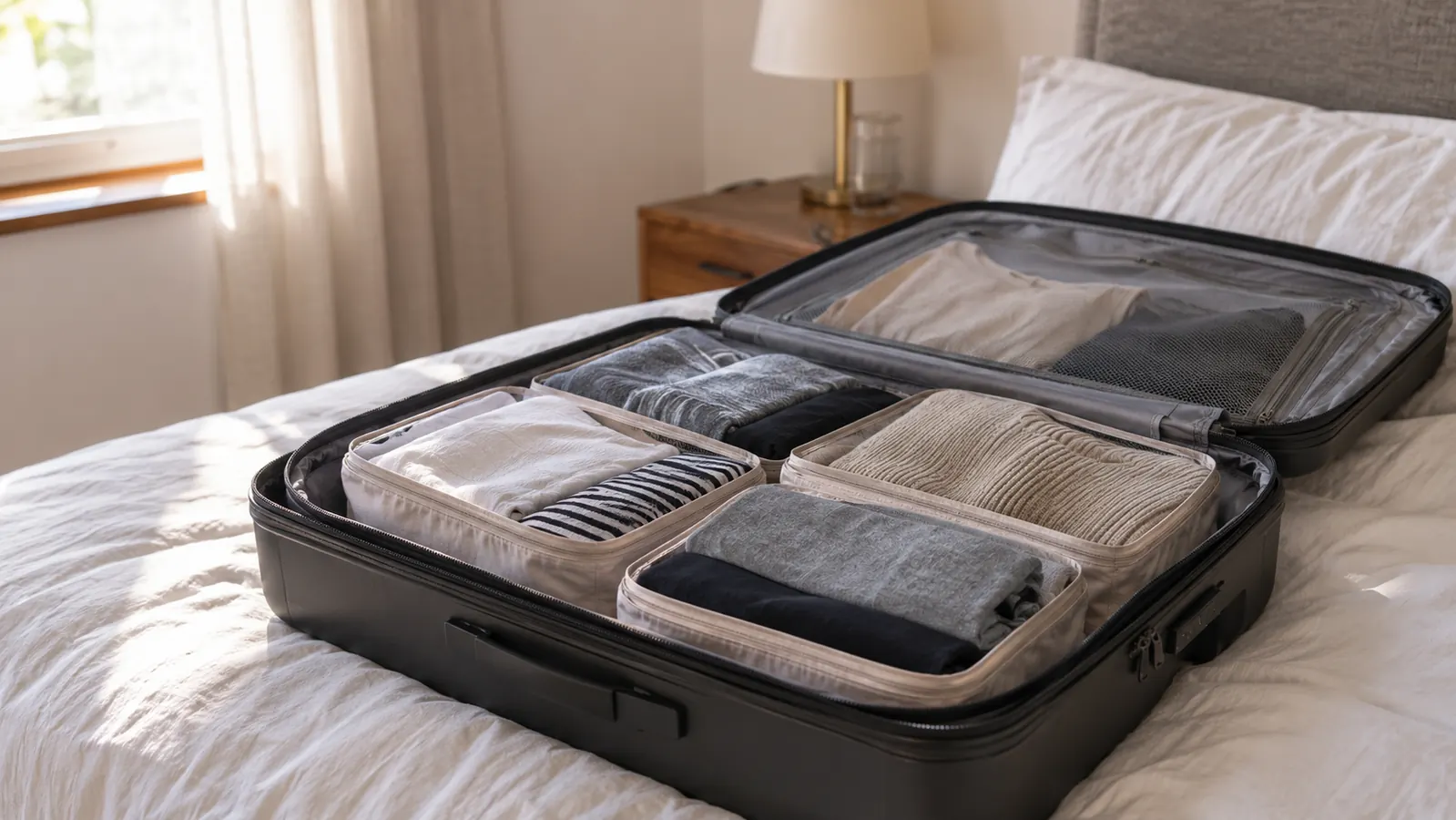
I have packed a suitcase for a living for twenty-six years. Not always my own. For most of that time I was booking trips for other people, and the travelers who came home unhappy were almost never unhappy about the hotel. They were unhappy because they could not find their own reading glasses at nine at night in a room in a strange city. That is the problem I was trying to solve two years ago, when I bought the BAGAIL 6 Set Packing Cubes in the same week I bought my Samsonite carry-on. I was not shopping for pretty. I was shopping for the feeling of opening a bag and knowing where everything is.
Here is the short version before the long one. Six nylon rectangles will not change your life, and I am suspicious of anyone who says otherwise. What they will do is turn a carry-on from a bag you dig through into a bag you read. I have used this set on every trip since the week it arrived, including two to Europe and a handful of domestic flights, and I have not gone back to zip-top bags. There are also three things about it that annoy me, and you should hear those before you spend anything.
The Quick Verdict
Six pieces that turn a carry-on into something you can read at a glance. Two years in, nothing has torn and no zipper has failed. It organizes; it does not compress, and six pieces is more than a short trip needs.
Amazon Check Today's Price →Six pieces of nylon, and a bag you can read in ten seconds
This is the same set that has been in my Samsonite on every trip since Portugal. Two years of travel, nothing replaced.
Amazon Check Today's Price on Amazon →How I've Used It
I bought the set in the same week as a Samsonite Omni PC hardside carry-on, the twenty-inch spinner. That was about two years ago, ahead of a spring trip to Portugal. The bag is listed at six point one pounds empty and it is the only bag I fly with now. The cubes went in for that first trip and they have come out only to be emptied.
Before them, I packed the way I had packed since the nineties: clothes rolled tight, pressed flat, then a layer of zip-top bags for the small things. It worked well enough that I defended it for years, including to clients who asked. What it did not do was survive a trip. By the fourth day the rolls had loosened into one soft mass, the zip-top bags had migrated to the bottom of the bag, and finding a clean shirt meant lifting out everything above it and setting it on the hotel bed in a pile I then had to repack. The first time I packed the Portugal bag with the pieces, I did it in the living room with the suitcase open on the ottoman and the empty pieces laid out in a row like baking pans. Fifteen minutes, no rolling. I have not rolled a shirt since.
Walt and I take about four trips a year. Two or three are domestic and short, two or three nights, and on those we share the one carry-on and check nothing. The longer ones, usually one or two a year, we each take our own carry-on and still check nothing. That is the whole system. It has not changed since the week I bought it, and I am not a person who leaves a good system alone.
The way it divides in practice: trousers in one piece, tops in another, underthings and socks in a third, and the charger bag and small electronics in a fourth. The two remaining pieces get used for whatever the trip is. On a longer one, one holds a folded rain layer and the other holds what I want at the top of the bag, which is my reading glasses, my medications and a small zip purse of local currency. Passports ride in a neck wallet under my shirt, not in the cubes, and that is a separate habit I would not give up.
The part I did not expect is that I stopped unpacking into hotel drawers. In Portugal I set the pieces on the closet shelf and lifted them out. In Ireland I did the same. There is a quiet pleasure in never wondering, at the end of a week, whether the thing you left in a drawer is still there when you zip up.

What Six Pieces Actually Do to a Carry-On
The listing gives the pieces at 17.32 by 13.78 by 3.94 inches and the set at 10.4 ounces. I have never measured mine; I have no reason to doubt it and better things to do with a Sunday. What I can tell you is how they sit. The footprint goes into a twenty-inch hardside with room left along the hinge side, and the set fills the bag to about the height of the closed lid. It is a fit, not a squeeze.
In my bag the layout settles into two rows. Three pieces go along the back wall, flat, and the other three sit in front of them toward the hinge. The trouser piece goes in first because it is the firmest and it sets the depth for everything behind it. Tops go on top of it, which sounds wrong until you see how clothing settles inside a piece once the lid presses down. Underthings go along the narrow side, where nothing else fits anyway. The charger bag, smaller than the rest, tucks into the gap at the end near the wheels. That gap is real, and it is the only place a hard-sided bag gives you anything for free.
The gain is not volume. The gain is that you can see the whole bag at once. When you pack flat, a carry-on is a stack, and everything you want is at the bottom of it. When you pack in pieces, a carry-on is a grid, and everything is at the top of its own little rectangle. That is the entire idea, and it holds up on the fourth day of a trip as well as the first, which is more than I can say for most organizing ideas.
They also solve the hotel-room problem, which nobody warns you about. A hardside bag opened on a luggage rack becomes a nest of loose clothing by day two. Pieces come out in one motion. You set them down. You are unpacked without having unpacked, and you can re-pack in about the same amount of time.
The listing rates the set at fifty pounds of load capacity, which is more than I would ever put in a bag I have to lift into an overhead bin. I have never come close to testing that number. The heaviest I have made one piece is a week of winter clothes, and the zipper did not complain.
Two Years In: Zippers, Nylon and Handles
This is the part that matters to me more than any of the organizing talk. Nylon is not a hard material. It abrades, it creases, and cheap zippers give up at the pull. After two years and about eight trips, the zippers on my BAGAIL pieces still run the full length without catching, and no tooth has separated. The nylon has softened at the corners of the piece I overfill, and there is a crease in one panel I cannot press out. Nothing has torn. No seam has opened.
That soft corner has a story. The first year I overfilled the piece I use for tops, on a cold week in Ireland, when I packed for weather and then talked myself into one more sweater. The zipper held, but it held hard, and I had to work it back with two hands while the taxi waited. I take the softened corner as a fair trade. A zipper that survives being asked to do too much once is a zipper I trust. I also washed one piece in a hotel sink that same week, after a coffee lid let go inside the bag, and it dried overnight on the towel rail without shrinking or going out of shape, which nylon will do if it is decent nylon.
The pieces have a handle at one end, and I use it more than I expected, mostly to pull a full piece out of a packed bag one-handed without disturbing everything else. That handle sits flat against the end, so it does not catch on the bag's lining when you slide the piece back in. Small thing. It is the kind of small thing that would have driven me mad every day for two years.
Weight is where this set earns its place. The listing puts the set at 10.4 ounces. The bag itself is six point one pounds empty. If you are the traveler who puts the bag on the bathroom scale before a flight, as I am, that is a rounding error, not a cost. I have watched a desk agent weigh a bag in front of me more than once in my life, and I have no intention of repeating it.
Two years, about eight trips, and no zipper has failed, no seam has opened, and the set still weighs what the listing says it weighs.
Where the Set Falls Short
It organizes. It does not compress. If you are hoping the cubes will buy you room, they will not. A piece full of sweaters takes up exactly as much space as a pile of sweaters, minus nothing at all. When I pack a winter coat I still wish for the other kind of bag, once a year, for about a minute. But I have heard enough from clients about vacuum bags and the business of finding a machine on the way home that I have never seriously considered switching. My packing problem was never volume. It was order.
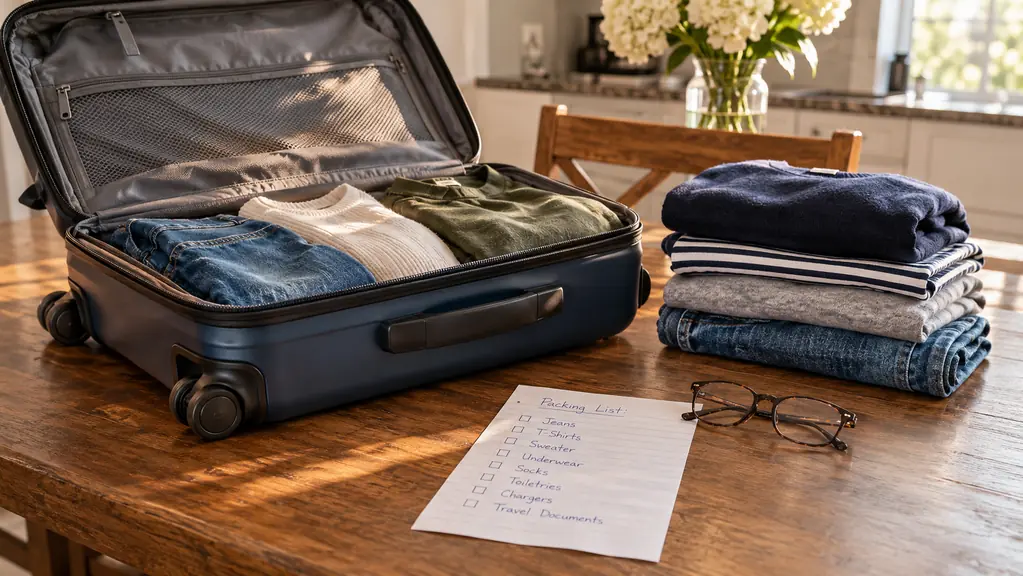
Let me give you the honest arithmetic from a short trip. Three nights, one city, one carry-on shared with Walt. Four pieces do the work: trousers and tops in two, underthings in a third, and the fourth for chargers and medications. The two spare pieces come along anyway, empty, because leaving them home means remembering to leave them home, and I never do. That is a good third of a very small bag doing nothing. On a longer trip it reverses and I have been grateful for all six. So the set rewards the traveler who takes at least one long trip a year, and mildly punishes the one who does not.
A full piece bulges, and a bulging rectangle in a hard-sided bag wastes the corners. I have learned to pack the trouser piece first and let the softer pieces fill around it. That is a technique, not a defect, but it is work you did not have to do before. And the BAGAIL set is sold as a set. I have not found a way to replace the one piece I use hardest without buying six again, which means I am careful with that one in a way I am not careful with the others.
What I Liked
- Six pieces turn a carry-on into something you can read at a glance
- Zippers and nylon have held through two years and about eight trips
- Adds almost nothing to the bag's weight; the set is listed at 10.4 ounces
- Rectangular shape stacks flat against the walls of a hard-sided carry-on
- Inexpensive enough that you stop babying it
Where It Falls Short
- Organizes but does not compress, so it will not buy you volume
- Six pieces is more than a short trip needs
- A full piece bulges and wastes the corners of a hard bag
- Sold as a set; replacing one worn piece is not simple
Who This Is For
If you fly carry-on only and you are tired of digging, this is the least expensive fix I know. It suits the traveler who packs a small number of things and wants to find them, which describes most of the people I book for over fifty. It suits anyone who shares a bag with a spouse on short trips, because the pieces make the dividing line obvious without a conversation. It suits the traveler who unpacks into a hotel closet and then spends the last morning hunting for a charger. And it suits anyone who, like me, reads the label before buying. The label here is honest: nylon, zipper closure, rectangular, 10.4 ounces.
Who Should Skip It
Skip it if you are a thrower. Some people pack by stuffing and they are perfectly happy, and pieces will only slow them down. Skip it if you are trying to fit a week into a bag that is already too small, because this will not create space. Skip it if you check a large suitcase and unpack it into drawers on arrival, since the organizing happens either way and you would be paying for a step you already take. And skip it if you want to replace one piece rather than six. The BAGAIL set is a system, and systems are bought whole.
The set that has been in my bag since Portugal
Two years, about eight trips, nothing replaced. If you want to stop digging through your own suitcase, start here.
Amazon Check Today's Price on Amazon →