

I have carried the HERO Travel Supply Neck Wallet on international trips for about three years now. It goes under my top on travel days, holds both passports when Walt and I fly, and I forget it is there until I reach for it at the hotel. I have never owned an anti-theft crossbody bag. I have compared plenty of them for clients, read the listings, and listened to what worked and what did not.
So here is the short answer. If your main worry is keeping passports and backup cards out of sight, the HERO Travel Supply neck wallet is the more secure choice. If your main worry is getting to your phone, glasses and daily money without digging under your clothes, a crossbody bag is easier to live with. They are not really rivals. They are two answers to two different questions.
| HERO Travel Supply Neck Wallet | Anti-Theft Crossbody Bag | |
|---|---|---|
| Where it rides | Under your shirt, flat against your chest | Across your body, at the hip or front |
| Concealment | Hidden by clothing, no strap or outline in view | Visible by design, often worn across the front |
| Getting things out | Pause, lift your shirt, unzip | Reach and open, no clothing to move |
| Passport capacity | Two passports, cards and cash in five compartments | Usually one or two passports, plus daily items |
| RFID shielding | Built-in multi-layer RFID lining | Varies by model, check the label |
| Everyday organization | Documents only, by design | Phone, glasses, keys and a small water bottle |
| All-day comfort | 2.3 ounces with an adjustable strap | Weight rides on the shoulder, more room to carry |
| Weather resistance | Water resistant ripstop nylon | Depends on the fabric and finish |
| Warranty | Lifetime replacement guarantee | Usually one year, varies by maker |
| Best for | Travel days and crowded transit | Sightseeing and daily carry |
How I Compared Them
I did this the way I plan a trip for a client. I started with the job each bag is asked to do, then looked at what it actually carries, how it feels after four hours, and what happens when you are tired and standing in a line. The HERO Travel Supply wallet is 0.2 inch deep, 5.5 inches wide and 8 inches high, and it weighs 2.3 ounces. It has five compartments and two sections, a zipper closure and an adjustable strap. The fabric is nylon, specifically ripstop nylon, with heavy duty YKK zippers and a multi-layer RFID lining. The listing also says each one is tested in the USA and carries a lifetime replacement guarantee.
For the crossbody side, I am not going to pretend I tested a specific bag for months. I have not owned one. I looked at the category the way I look at a hotel I have not stayed in: what does it promise, what do clients say, and what does it leave out? The anti-theft crossbody bag is built around visible security. It usually has a zippered main compartment, a strap that crosses the body, and sometimes locking zippers or a slash-resistant strap. The good ones are designed to be worn in front, where your hand can rest on them. That is a different kind of protection from concealment, and it is worth understanding before you choose.
I also compared them on the plain facts of a travel day. A passport needs to come out at the airline counter, sometimes at security, and again at passport control. A phone needs to come out for a boarding pass. Glasses come out on the plane. Cash comes out for a coffee. The question is not which bag is better in the abstract. It is which one handles your actual day with less fumbling and less risk.
Where HERO Travel Supply Wins
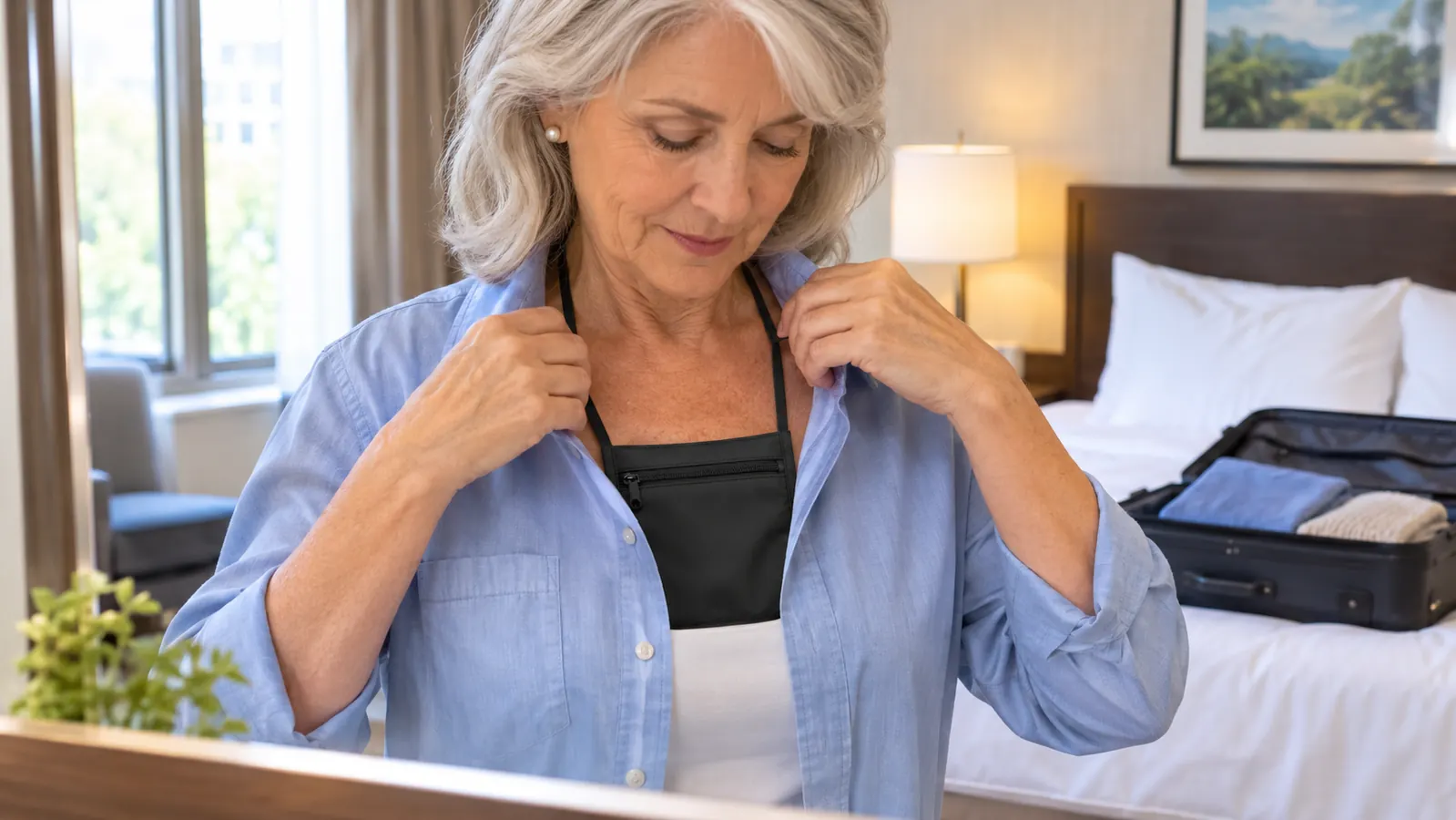
The first win is concealment. When I wear the HERO Travel Supply neck wallet under a blouse or a light sweater, there is no strap across my back and no bag hanging at my hip. A pickpocket works on what he can see and reach. He cannot see this. On a crowded train platform in Rome, I zipped both passports into it, tucked it under my top, and patted it once through the fabric. That was the whole routine. It is not a guarantee against a determined thief, and I do not treat it as one. It is simply harder to get to than a bag hanging in the open.
The second win is capacity for the job it is meant to do. It holds two passports, a backup credit card and some local cash in those five compartments. For Walt and me, that means I carry both passports on travel days and he keeps his hands free. The wallet is 2.3 ounces, so it does not pull at my neck the way a small purse would. The ripstop nylon has handled rain in Ireland and a spilled water bottle in a rental car without soaking the contents. The zippers are YKK, which matters to me because I have had cheap zippers fail on a suitcase and it is a nuisance I do not want near a passport. The lifetime replacement guarantee is also unusual in this category, and I read that fine print before I bought it.
If you want your passports hidden, not just zipped, this is the one I wear
The HERO Travel Supply Neck Wallet keeps two passports, a backup card and local cash flat against you under a shirt. It weighs 2.3 ounces, has a multi-layer RFID lining, ripstop nylon and an adjustable strap. It is the one I reach for on travel days.
Amazon See the HERO Travel Supply Neck Wallet on Amazon →Where an Anti-Theft Crossbody Bag Wins
A crossbody bag wins on access, and it is not close. At a museum, you want a tissue, your phone, your glasses and maybe a small bottle of water. You do not want to lift your shirt in public every time. A crossbody bag lets you reach in and zip back up in one motion. The ones I have looked at for clients often have a front pocket for a phone and a main compartment for a small wallet, and some have locking zippers that make a thief work harder. That visible hardware is its own deterrent. It says, I am secured, and I am right here in front of the person who owns me.
The second win is comfort over a long day of walking. A neck wallet is light, but it is still around your neck, and in July heat a strap under a shirt can feel warm. A crossbody bag puts the weight on your shoulder and lets you carry more: sunscreen, a folding umbrella, a guidebook, a water bottle. If you are the traveler who wants one bag for the whole day, the crossbody is the more practical shape. It also works with a dress or a light jacket without asking you to change how you dress. I would still wear it in front in a crowd, not swung around to my back, but that is a habit, not a failing of the bag.
The Details That Decide It
The word anti-theft covers two different ideas. A hidden neck wallet relies on concealment. A crossbody bag relies on visible barriers: zippers, clips, straps and the fact that the bag sits in front of you. Neither one is magic. A hidden wallet can still be found if someone is determined and you are careless. A crossbody bag can still be opened if you leave it hanging behind you. The right question is which kind of security you will actually use every day of the trip.
Passport handling is the clearest test. At the airline counter, I need to hand over two passports. With the neck wallet, that means unzipping, pulling them out, handing them over, and putting them back. It takes a few extra seconds, and I do it at the counter, not in the middle of a crowd. With a crossbody bag, the passports are in a compartment at my hip and I can get to them without moving my shirt. If you are traveling alone and handling documents frequently, that convenience is real. If you are like me and only need them at the counter and at passport control, the extra seconds are worth the concealment.
Clothing matters too. The HERO Travel Supply wallet works best under a top with a little room, or under a light sweater. In summer, I wear it over a thin cotton tee and under a loose button-down, and I can feel it against my ribs. It is not invisible to me. It is invisible to everyone else, which is the point. A crossbody bag works with almost anything, but it is always part of the outfit. Some travelers mind that. Some prefer it, because they can keep a hand on it.
At 2.3 ounces, the HERO Travel Supply Neck Wallet disappears under a shirt and still holds both passports, a backup card and local cash.

What I Carry and How I Wear It
On an international travel day, I put both passports, a backup credit card and some local cash in the HERO Travel Supply wallet. I zip it, tuck it under my top, and adjust the strap so it sits flat against my ribs. Day spending money goes in a small ordinary zip purse in my tote. That way, if I need a coffee or a train ticket, I am not opening the passport wallet in public. The passports stay put until I need them. This is the routine I have used for three years, and it is the one I recommend to clients who ask me how to carry documents without a money belt.
I do not wear it around my hotel room, and I do not sleep with it. At the hotel, the passports go in the room safe when there is one, and the wallet goes in my carry-on with the rest of my documents. On travel days, it stays on me. That is the balance I have landed on. The wallet is a tool for transit, not a permanent attachment. If you are the kind of traveler who wants one bag for every hour of the day, a crossbody bag will feel more natural.
Walt does not like anything around his neck, so I carry both passports. That is one reason the capacity matters to me. If he carried his own, I would still use the neck wallet for mine and a backup card. The point is not that every couple needs to do it my way. The point is that the wallet has enough room for two passports without becoming a bulge, and that is a specific advantage for couples who travel together and want one person to hold the documents.
Questions Clients Ask Me
The first question is usually about comfort. Is a neck wallet annoying? For me, no, because it weighs 2.3 ounces and the strap adjusts. But I am not going to tell you it disappears. In heat, you will feel it. If you hate anything against your chest, you will hate this. That is an honest limitation, and it is why I do not recommend it to every client.
The second question is about RFID. The HERO Travel Supply wallet has a multi-layer RFID lining, and that is a real feature in the specs. It is not a reason to stop paying attention. RFID blocking helps with a specific kind of electronic scanning. It does not stop a person from opening a bag or reaching into an unzipped pocket. I treat it as one layer, not the whole plan.
The third question is whether a crossbody bag is safer because it is visible. My answer is that visible security and hidden security solve different problems. A visible bag with a lock tells a thief that the easy grab is not going to work. A hidden wallet tells a thief that there is nothing to grab in the first place. If you are in a crowded market and you tend to set your bag down, a crossbody you keep on your body is better than a bag on a chair. If you are in a crowd and you want nothing showing, the neck wallet is better.
The fourth question is about age. I am 63, and I have been a travel agent for 26 years. I do not think there is one right answer for older travelers. I think there is a right answer for how you move. If you use a cane or need your hands free, a neck wallet is easier. If you need quick access to medication or a phone, a crossbody bag is easier. Choose the one that fits your day, not the one that sounds more rugged in a listing.
Who Should Buy Which
Buy the HERO Travel Supply Neck Wallet if you carry a passport on travel days and want it hidden. Buy it if you and your spouse travel together and one of you carries both passports. Buy it if you wear tops with a little room and you do not mind lifting a hem to get to your documents. Buy it if you want a light layer of RFID protection and you like the idea of a lifetime replacement guarantee from a company that says it tests each wallet in the USA. It is also a good fit if you are in and out of trains, stations and crowded streets where you do not want a bag visible at your side.
Buy an anti-theft crossbody bag if you want one bag for the whole day and you need to reach your phone, glasses, tissues and a small water bottle without fuss. Buy it if you prefer visible security with locking zippers and a strap across your body. Buy it if you hate anything around your neck or under your shirt. Buy it if you are sightseeing and you want your hands free but your essentials in front of you, not buried in a tote. It is the more practical choice for daily carry, even if it is the less hidden choice.
You can also use both, and many travelers do. The neck wallet holds the passports and backup card on travel days. The crossbody bag holds the daily items. That is not overkill if you already own a small crossbody. It is just a division of labor. The mistake is expecting one bag to be invisible and quick-access at the same time. It cannot be both.
The bag you forget you are wearing is the one that keeps your documents close
For travel days, the HERO Travel Supply Neck Wallet is the layer I trust: two passports, a backup card and local cash, hidden under a shirt, with RFID lining and a 2.3 ounce build. If your day calls for quick access, pair it with the bag you already carry.
Amazon Check the HERO Travel Supply Neck Wallet on Amazon →