
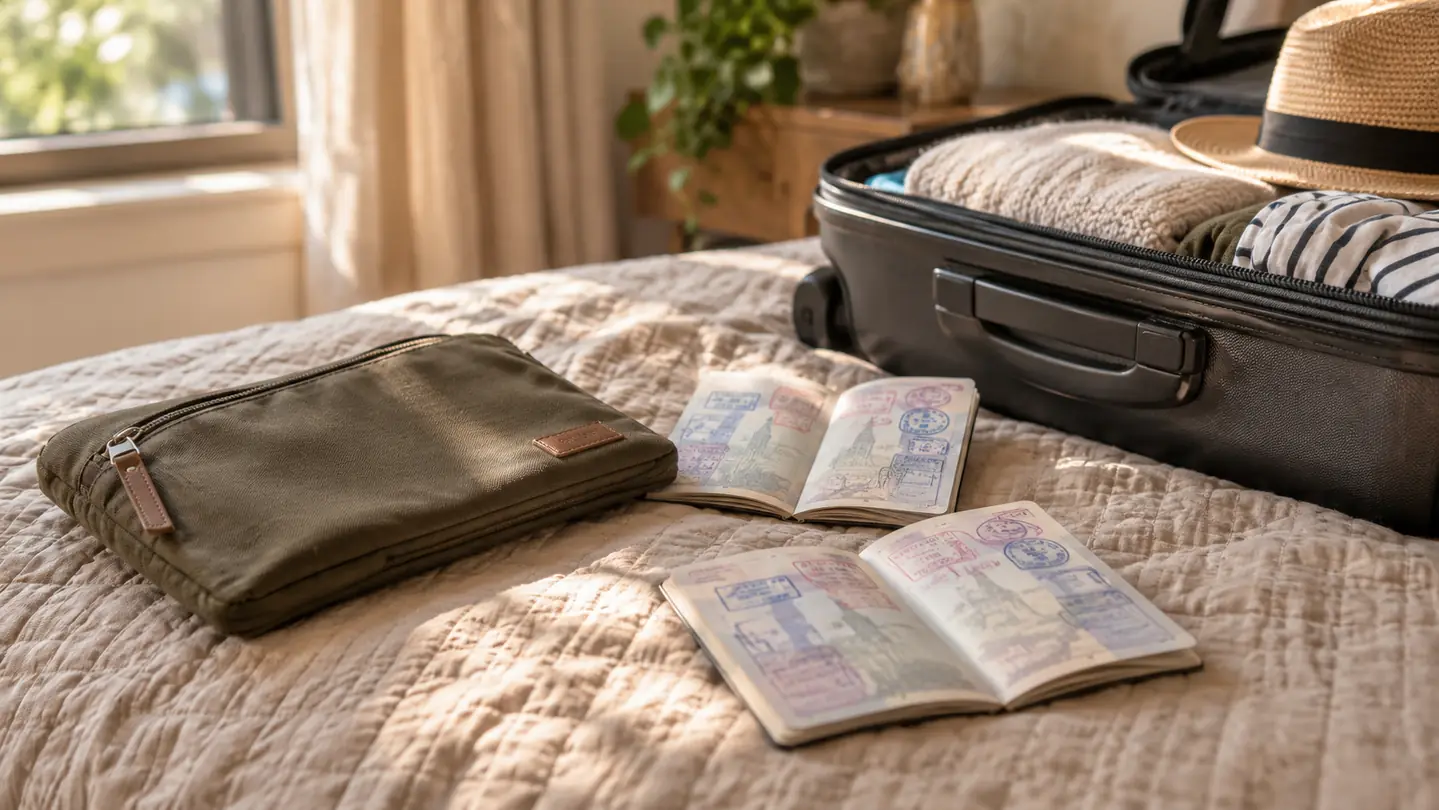
Three weeks before a trip to Italy, I do what I have always done. I spread everything out on the guest bed and ask myself what could go wrong. I have been a travel agent for twenty-six years, twenty of them full time, and the honest answer is almost never the flight or the hotel. It is the passport, and where that passport lives for two weeks while you walk through train stations and crowded markets with your attention on everything except your own chest.
That is why, about three years ago, I bought the HERO Travel Supply Neck Wallet. It is a flat nylon pouch on an adjustable strap that you wear under your clothes, and the listing calls it an RFID blocking passport holder with a lifetime replacement guarantee. I bought mine on Amazon with my own money, the way I buy everything I write about. It has been to Italy, Portugal and Ireland since, plus a handful of domestic trips, and I have opinions about it now.
The Quick Verdict
A flat, well-built place to hide two passports and a backup card under your shirt. The nylon and the zipper have held up for three years. It does not breathe on a hot day, and it will not watch your bag for you.
Amazon Check Today's Price →The pouch goes on before my coat does
Ripstop nylon, YKK zippers, an RFID lining and five compartments in 2.3 ounces. It is the first thing I put on when we leave for the airport.
Amazon Check Today's Price on Amazon →How I've Used It
I bought mine in the same month I booked a client's Italy itinerary and then booked our own. It arrived folded flat in a plastic sleeve. On the kitchen scale it came in at 2.3 ounces, and the tag gave the size as 8 inches tall, 5.5 inches wide and 0.2 inches deep. Empty is the word to hold on to there, and I will come back to it. Walt laughed at me when I put it on in the hallway. He laughed less when I handed him his passport at the Florence train station without opening my handbag.
On an international trip it carries both passports, mine and Walt's, one backup credit card that stays in the pouch for the whole trip, and some local cash in the zip pocket. Our day spending money lives in a small ordinary zip purse in my handbag, because I am not opening my shirt in the middle of a market to pay for a coffee. Walt does not wear one. His passport goes in mine, an arrangement we settled on before Italy and have not changed since.
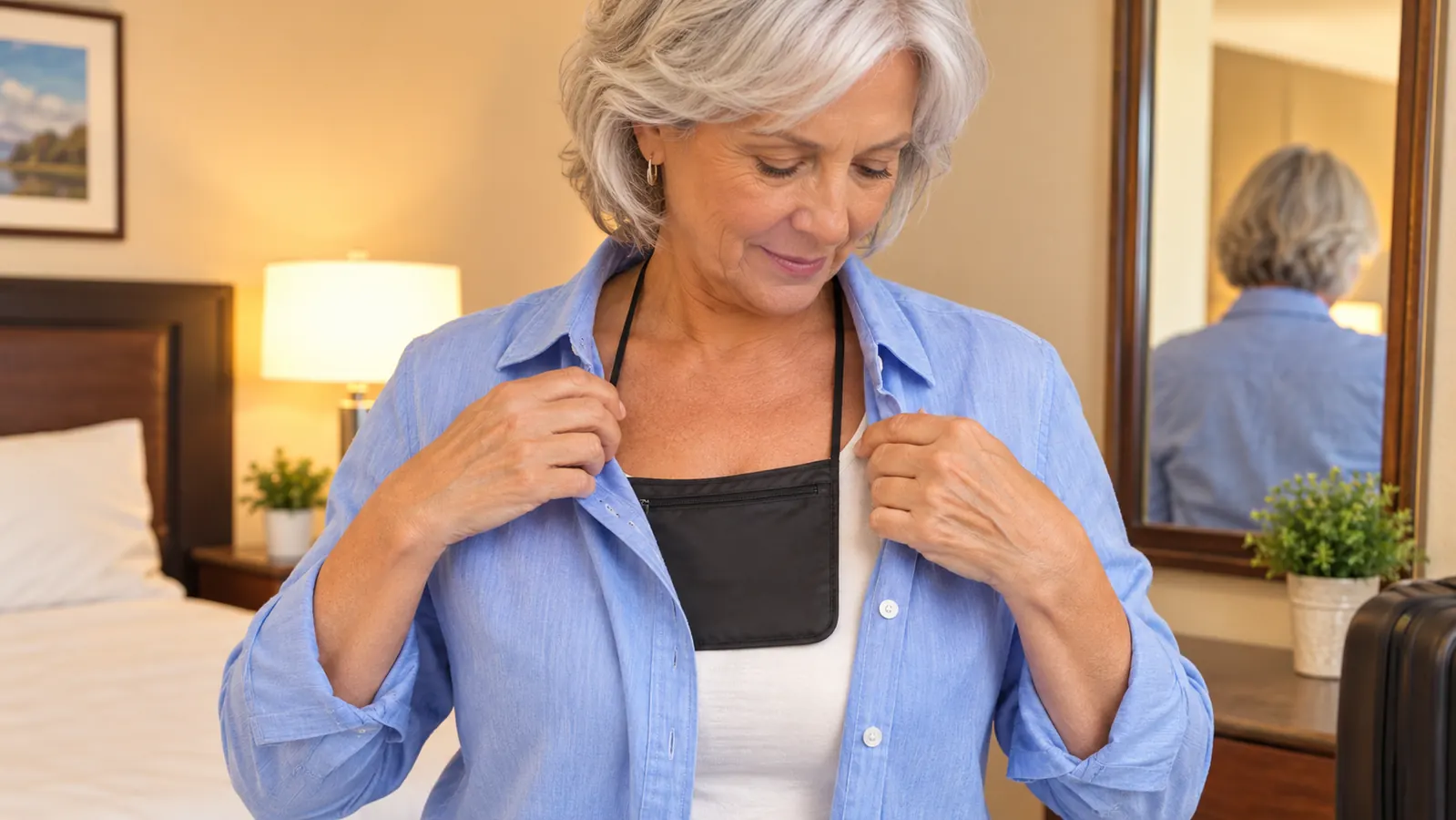
The strap adjusts, and I wear the pouch under my top, flat against my sternum, from the moment we leave the house outside Madison until we are in a hotel room with the door locked behind us. On a two or three night domestic trip it usually stays in the suitcase, because there is nothing on it worth hiding. It comes out for airports, train stations, and any city where I expect to be standing still in a crowd.
The habit took about one trip to build. Before we leave the room I put the pouch on first, then my top, then I check both passports by feel through the fabric. At security I keep it on and it has never caused a problem. In the room at night it goes on the nightstand with the passports still inside, and in the morning it goes back on before I have had coffee, because I know myself.
What the RFID Lining Actually Does
Here is what the lining is for, in plain words. Modern credit cards, bank cards and newer passports carry a small chip that can be read by a radio signal at very close range. A skimmer has to be near you, often inches away, and it has to know what it is doing. The multi-RFID layers in this pouch sit between those chips and the outside world. The listing is specific about that, and I read the label because I always read the label.
I tested the claim the only way a person at a kitchen table can. I put a contactless bank card in the main section, closed the zipper, and held the pouch flat against the card reader at the grocery store on the corner. Nothing happened. I took the card out and it paid on the first tap. That is not a laboratory test and I would not call it proof. It is enough for me to believe the lining is doing something besides adding weight.
I want to be straight with you about the limit of it, though. That lining cannot stop a hand. If someone reaches into your shirt, a pouch is still a pouch. What it does is make the reaching harder, because the thing they want is not hanging off your shoulder in a bag with a nice easy zipper running along the top. On a crowded vaporetto in Venice, that mattered to me more than any technical claim on the box.
What It Holds, and What It Doesn't
The listing gives five compartments and two sections, with one of them sized for a passport. That is accurate. Two passports, one behind the other, fit in the main section with room to close the zipper without forcing it. The backup card goes in one of the smaller slots, the cash folds into the zip pocket, and a folded paper boarding pass slides in beside the passports if you still print yours the way we do.
What it will not do is hold everything. I do not carry my phone in it. The listing says a large phone will fit without a bulky case, and I believe it, but I want my phone in my hand at the airport, not behind a button. So the phone stays in my handbag and the pouch holds paper. If you are looking for one place for passport, phone, cards and cash, this is not that, and I am not sure it should be.
And here is the honest arithmetic of it. The pouch is 0.2 inches deep when it is empty. Put two passports and a card inside and you are closer to three quarters of an inch, which is a lump. Under a jacket nobody sees it. Under a blouse, people who look will see a shape, and after three years I have decided I do not care.
Three years, four countries, and the zipper still runs the way it did the first week. Nothing has ever gone missing out of it.
Three Years of Zippers and Nylon
The fabric on the HERO Travel Supply pouch is ripstop nylon and the zippers are YKK, and after three years of trips both are still doing their jobs. There is no fraying at the corners. The zipper pull has not come loose and the slider has not started skipping. The strap adjuster holds where I set it and has not slipped once, which is more than I can say for a few things in my suitcase.
It has been rained on. We walked most of an afternoon through a soft Irish drizzle a couple of years back and got properly wet, and the passports inside were dry when we reached the hotel. The listing says water resistant and that matches what happened, though I would not call it waterproof and neither does the label.
Care has been nothing at all. I have never washed it. It comes home, goes in the top drawer of the dresser in the guest room with the passports still inside, and comes back out the night before the next trip. The listing carries a lifetime replacement guarantee and says each wallet is tested in the USA before shipping. I have never needed to use the guarantee, so I cannot tell you how it is honored. I can tell you the pouch has not given me a reason to find out.
Where It Falls Short
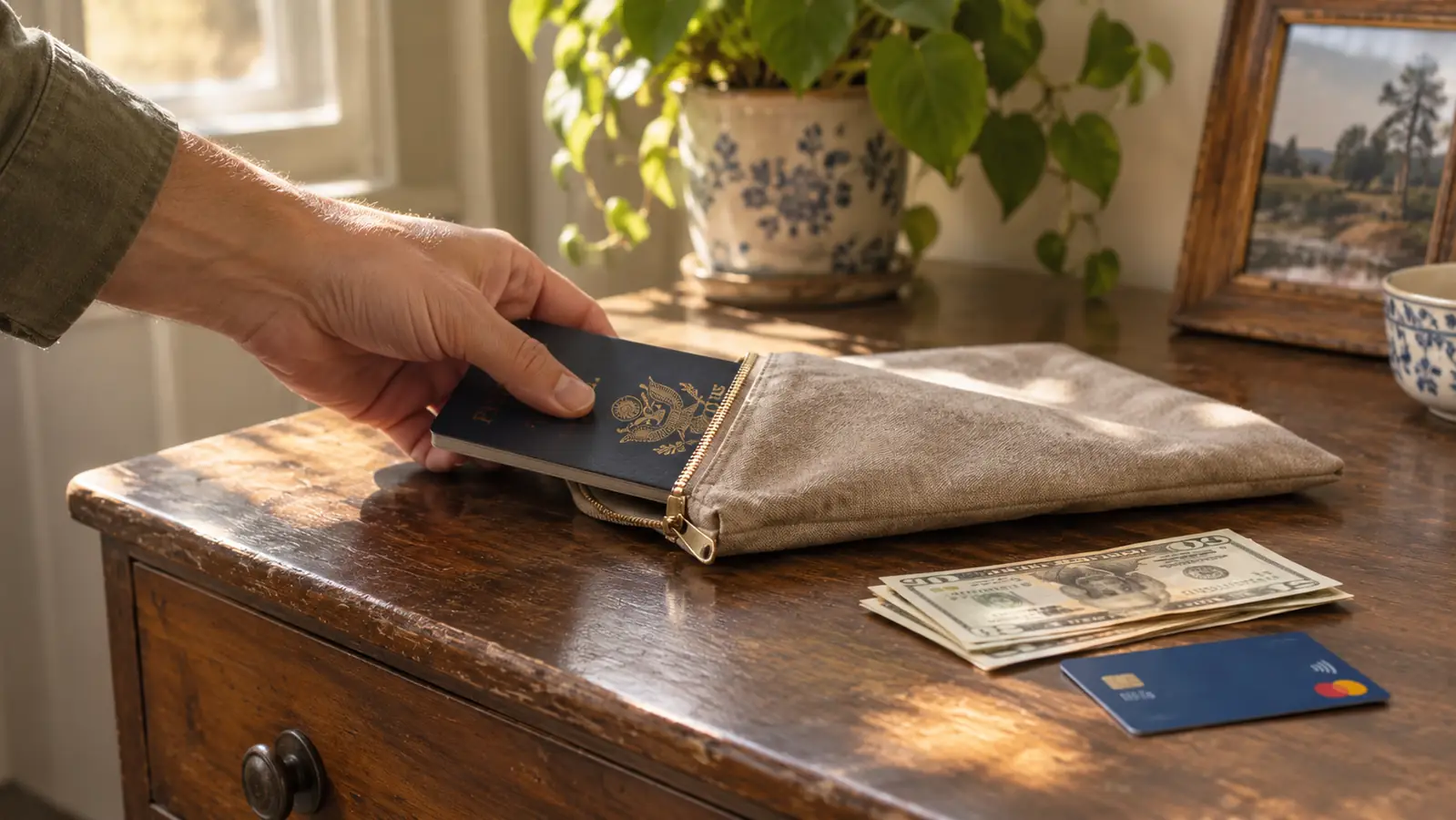
It gets damp. That is my main complaint after three years and I want to be honest about it. Nylon against bare skin in August in Rome is not comfortable by the end of a long day, and the strap can chafe the back of your neck if you have it set too long. I set mine shorter and higher on the chest and it stopped. Walt, who runs warm, would not wear it at all.
Second, it makes you commit. To get a passport out you have to open your shirt or lift your top, which is not a thing you want to do at a ticket counter with a line behind you. I have learned to have the passport in my hand before I reach the desk and to put it back afterward. One trip was enough to teach me that, and it is a habit now rather than a nuisance.
Third, the size. Eight inches tall is not small. It covers a good part of your chest, and under a fitted top it reads as a rectangle. If you are somebody who dresses up on travel days, this is going to fight with what you are wearing. I wear a looser shirt and a scarf in cool weather and it disappears.
And fourth, the one I care about most: it is a hiding place, not a security system. It does nothing for the bag you set down beside your chair at a cafe and nothing for the phone you leave on the table. I have clients who will not travel without a crossbody bag worn in front of them. I have looked at the listings for those bags and never bought one, so I will not pretend to compare them here. I will only say that a pouch under your shirt solves one problem and leaves the rest alone.
What I'd Change
Two things. I would like a smaller version for day use, something that holds one card and folded bills and sits closer to the collarbone, because the full pouch is more than I need on a museum afternoon. And I would like a softer edge on the strap where it crosses the back of the neck. Those are small requests from somebody who has used the thing for three years and plans to keep using it, not complaints.
What I would not change is the size of the main section. It is the reason two passports fit and the reason I have never once had to force a zipper. Slim the pouch down and it stops doing the one job I bought it for.
What I Liked
- RFID lining I could test myself: a contactless card would not read through the closed pouch
- Ripstop nylon and YKK zippers that have gone three years without fraying, sticking or slipping
- 2.3 ounces, so it disappears into a suitcase on trips when you are not wearing it
- Five compartments and two sections, enough for two passports, a backup card, cash and a folded boarding pass
- An adjustable strap that sits flat under a shirt or over one
- A lifetime replacement guarantee on the listing, even though I have never needed it
Where It Falls Short
- Nylon against the skin is damp and warm by the end of a hot day
- The 8 by 5.5 inch body shows as a rectangle under a thin or fitted top
- Two passports fill it, so the phone and paperwork have to live somewhere else
- Opening it in public means opening your shirt
- It protects what is on your body and nothing else, so your bag still needs watching
Who This Is For
This is for the traveler who wants documents on their body and not in a bag. If you fly internationally once or twice a year, if you are the one in your marriage who carries both passports, if you wear a shirt with a collar on travel days, this earns its place. I have recommended the HERO Travel Supply neck wallet to clients in their sixties and seventies more than any other item in my own suitcase, because the whole point is that you stop setting the important things down.
It is also for someone who has already had a scare, or heard about one from a friend, and wants a small change in habit rather than a whole new way of traveling. You put it on. You forget it. That is the entire behavior it asks of you, and it is the reason it works.
Who Should Skip It
Skip it if you run hot, if you dress in thin fitted tops on travel days, or if the idea of a strap against your neck for six hours makes you itch just reading about it. Skip it if you want your phone, passport and cash in one place within reach, because this is not that pouch. And skip it if you know in your heart that you will not wear it every travel morning, since a hidden pouch in a drawer protects nothing.
One more thing, because I would rather say it than not. If you are the traveler who sets a bag down and walks three steps away from it, no pouch on the market fixes that. It is a good tool and it is not a substitute for keeping your hand on your things.
Three years in, I still put it on first
If you want your passports and backup card under your shirt instead of in a bag, this is the one I have used since Italy. It is 2.3 ounces, it has five compartments, and the zipper still runs.
Amazon Check Today's Price on Amazon →