
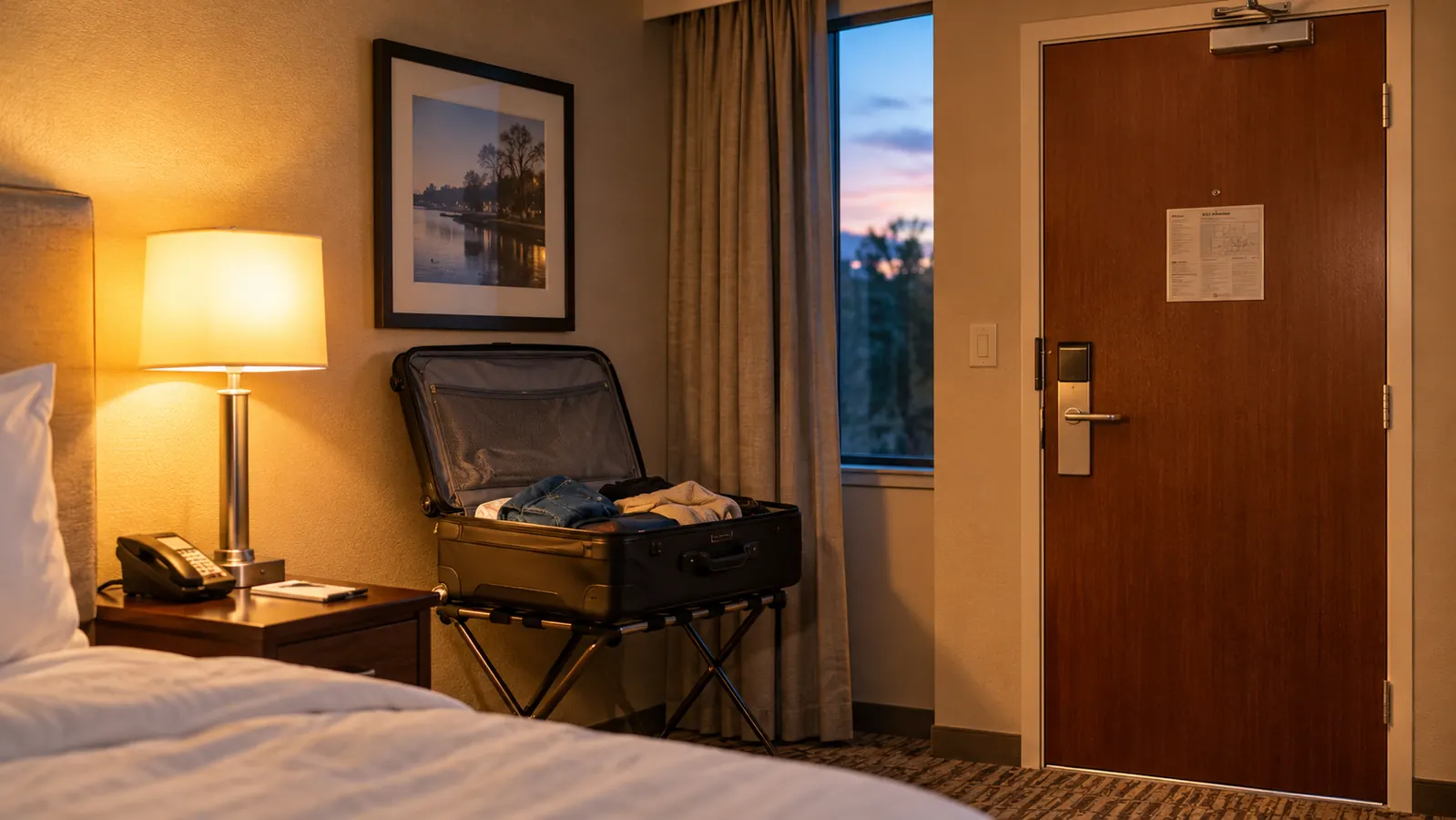
I bought the Addalock Original two and a half years ago, and I want to start with the part most reviews leave out: for my first three hotel nights with it, I used it wrong. Not dangerously wrong. Just wrong enough that it did nothing at all. A client had told me about a room where the door did not latch properly, I ordered one that same week, and then I stood in a hotel outside Milwaukee with a small stainless steel piece in my hand and no notion of which way it faced. So this is not a review that opens with how clever the thing is. It opens with the fact that a travel lock you have not practiced with is four ounces of metal in a zip pocket.
Two and a half years and about two dozen hotel nights later, I still carry it, and I still check it before I unpack. That is the short version. The longer version involves door frames that did not cooperate, one hallway in Portugal where I was glad of it, and a habit I built slowly and by getting it wrong first. If you are deciding whether to spend money on one, the useful thing I can give you is not enthusiasm. It is the list of doors it works on, the ones it does not, and the things I wish someone had told me in the first place.
The Quick Verdict
A well-made one-piece latch lock that works on inward-opening doors and does nothing on the rest. Practice at home on a Sunday afternoon, not at eleven at night in a strange city.
Amazon Check Today's Price →The four ounces I check before I unpack, not after
One piece of stainless steel. No batteries, no codes, no app. About fifteen seconds once you have practiced it, and it has held on every inward-opening hotel door I have put it on.
Amazon See It on Amazon →How I've Used It for Two and a Half Years
The Addalock lives in the small zip pocket on the inside of my carry-on lid, the one that also holds a spare hair tie and a folding sewing kit. It went in there the week I bought it and it has come out on every trip since. My routine is identical each time. First night, before I unpack, I take it out and set it up. Morning, before I leave, I put it back in that same pocket. The mornings I have skipped that step are the mornings I have spent ten minutes patting down the inside of a suitcase in a hotel lobby while Walt waited by the elevator with his coat on.
I have used it in chain hotels and in a small family-run place in Portugal where the room key was attached to a brass weight the size of my palm. I have used it in a converted convent in Ireland where the door was older than anything in my own house and the frame had been painted so many times the edges had gone soft. I have used it in a rented flat in Rome where the stairwell light ran on a timer and the elevator was a cage you operated yourself. It worked on all of those doors, because all of those doors opened inward into the room.
What it gave me in those rooms was not adventure. It was the ability to stop thinking about the door. I am 63. Walt is 65. We are long past the age where either of us finds it amusing to wedge a chair under a handle and call that security. Walt calls it my door thing and he does not carry one of his own, which tells you something about how necessary a man of his age believes it to be, and something about how often I have been the one doing the checking. That is not a complaint. It is a division of labor that has held for forty years.
What the Addalock Actually Is
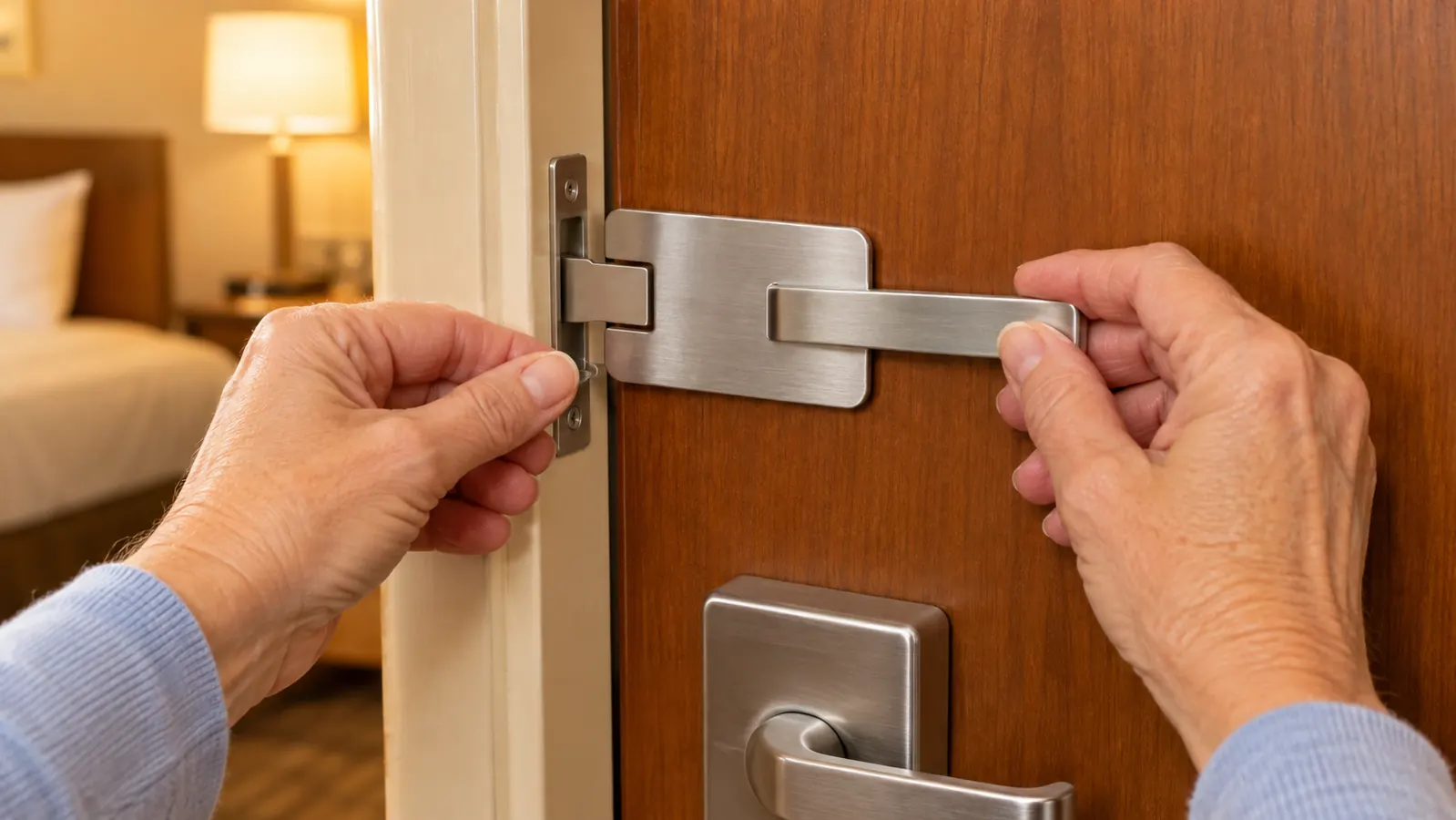
Strip away the packaging and it is one piece of stainless steel, 5.8 inches by 3.5 inches by 0.7 inches, 4.2 ounces on my kitchen scale, rated for indoor use. It is made by Rishon Enterprises, the company behind the original design, and the listing is careful to say so. I have handled the copies sold in airport shops and the difference is weight. The knock-offs feel like something that would bend if you looked at it wrong. Mine has been dropped on tile, sat on, and shoved into a carry-on four times a year, and it is still straight.
There is no key, no code, no battery, and nothing to charge. That is the whole appeal for me. In two and a half years there has been nothing to reset, nothing to go flat in the bottom of a bag, and nothing to explain to a security officer at six in the morning. When you travel four times a year and you are not a gadget person, the value of a thing that simply works is higher than the value of a thing that works cleverly.
It also leaves no mark on the door. You are not screwing anything into a hotel's property and you are not taping anything to a frame, which matters if you would rather not have a conversation with the front desk at midnight. In all that time I have had exactly one comment about it, from a housekeeper in Portugal who saw it, laughed, and said something to her colleague that I decided not to ask about. Nothing was damaged and nothing was said to me afterward.
Installation: The Two Minutes Nobody Warns You About
Here is what nobody tells you about the first night. The piece is not self-explanatory. It is a shape, and the shape only makes sense once you have seen it seated correctly on a door. The insert that comes with it is small and printed in a way that assumes you are already holding it the right way up. I am a person who reads the label and the fine print, and I still got it backwards and slept with a false sense of security, which is worse than no security at all, because you do not know you are unprotected.
The fix is a Sunday afternoon at home. Open your own front door, seat the Addalock, close the door, and try it from the outside with your key in your pocket. Two minutes. Maybe three if you are like me and want to read the insert twice. After that the motion is in your hands and you will never fumble with it in a hotel corridor. I have talked two clients through it over the phone and both of them called me back to say it was easier than they expected, which is not the usual report I get on travel gear.
Once you know it, the whole thing takes about fifteen seconds, and most of that is bending down. You open the door, place the piece at the latch, and close the door on it. From the hallway side the door does not move. That is the entire procedure. There is nothing to adjust and nothing to align beyond making sure the piece is seated flat and the door is fully shut, and you can feel both of those things with your hand.
Two habits I would pass on. Do it before you are tired, because the nights I fumbled were the nights I had been on a plane for nine hours with a connection in a terminal that smelled of cinnamon. And check it from the hall once, properly, with your key card in your pocket so you can get back in. Push the door. If it gives, you have it wrong, and you want to learn that while you are still dressed, not at two in the morning in your nightgown.
If it takes force, it is not working, it is just stuck. There is a difference, and you can feel it in your hands.
Fit: The Doors It Works On and the Ones It Does Not
The Addalock is for doors that swing inward, into the room. That is the first and largest condition. On a door that opens outward, on a sliding door, on a balcony door, it does nothing. I am blunt about that because I have read complaints from people who felt misled, and I do not think the complaint is fair to the product. A one-piece latch lock depends on the door closing against it. If the door swings the other way, there is nothing for it to do. If you are booking a cruise or a cabin where the door opens to the corridor, check before you count on this.
The second condition is the frame. Older European hotels sometimes have frames that are deeper or shaped differently from what we are used to at home, and I have had one or two rooms where the piece sat loosely enough that I did not trust it. In those rooms I used the hotel's own deadbolt and chain, put the Addalock back in the bag, and slept fine. It is a tool, not a religion. A tool that does not fit the job goes back in the toolbox, and I do not spend the night arguing with it.
The third condition is the door itself. If the door sits flush and the frame is square, the piece seats cleanly and the sound it makes is a quiet, solid one. If the building is old enough that nothing is square, or the door is warped from years of humidity, it may sit at an angle. My rule is the one I gave you above. If it takes force, it is not working, it is just stuck. I have never damaged a hotel door, and I intend to keep that record.
What It Will Not Do
It will not stop a determined person with tools and time. Nothing you can put in a hotel room will, short of a bar across the frame that no hotel is going to let you install. What it does is make the door impossible to open quietly and slow to open at all, and for the worry most of us carry in a strange city at night, that is the relevant threshold. Travel lock marketing can get carried away, and I would rather you bought this with an accurate picture in your head. It is a deterrent and a delay. It is not a vault.
It will not give you privacy from someone you are sharing the room with. That is not the job and it was never sold as the job. It will not help if the real risk is a front desk handing your key to the wrong person, which, in twenty-six years of booking other people's trips, is the story I have heard more than any other. A lock on the inside of the door does not touch that problem. Neither does a door stop alarm, for what it is worth.
And it will do nothing at all if it is in the suitcase. I say that as a woman who has done it twice. Once in Chicago, and once in Madison, which is worse, because I was twenty minutes from my own front door and had no excuse at all. A lock is only as good as the habit around it, and the habit takes about three trips to set.
The Alternatives I Thought About
I looked at door stop alarms before I bought this, and I have never owned one, so take the following as the reasoning of a woman reading listings rather than as a test. My hesitation was the battery. An alarm that has gone flat is a doorstop, and a doorstop under a door that opens inward only works if the floor is the right kind of surface and the gap under the door is the right size. Hotel rooms vary on both counts. The Addalock has no battery, which for me settles the question.
A wedge is the other option, and it carries the same floor question plus the small matter of tripping over it in the dark on the way to the bathroom. I have clients who swear by both of those, and I am not going to tell them they are wrong. I will tell you that at my age I want fewer things to remember. One piece of steel that lives in a zip pocket and never needs charging is the version of security I can actually keep up with on the fourth day of a long trip.
What I Liked
- One piece of stainless steel, 4.2 ounces, nothing to charge or reset
- About fifteen seconds to seat once you have practiced it at home
- Leaves no mark on the door and needs no tools or tape
- Has held on every inward-opening hotel door I have tried it on
- Small enough for the zip pocket of a carry-on and easy to keep there
Where It Falls Short
- Useless on outward-opening doors, sliding doors and balcony doors
- Not self-explanatory the first night, and the insert is small
- Old or warped frames can make it sit at an angle you should not trust
- A deterrent and a delay, not something that defeats tools and time
- Easy to leave in the room if you do not build the habit
Who This Is For
If you stay in hotels or rentals a few times a year and the door opens into the room, this is worth the space in your bag. It weighs 4.2 ounces and takes up less room than a pair of socks. If you are a woman traveling alone, or two people in their sixties who would rather not rely on a chain that has been painted over six times, it earns its place. If you have ever lain awake listening to a hallway, you already know what it is for and you do not need me to explain it.
It is also for the person who likes to read the label. The instructions are brief and the device is simple, and if you give it ten minutes at home you will get years out of it. I have had mine two and a half years. It has never failed, never bent, and never been left behind except the two times I mentioned, which were my fault and not the lock's.
Who Should Skip It
Skip it if your trips are mostly cruises, or if the places you stay have doors that open outward. Skip it if you want something that secures a door without you having to think about it, because this asks for a small amount of attention on the first night. Skip it if you are the sort of traveler who will not practice at home. An unpracticed lock is a piece of metal, and I would rather you kept your money than bought something you will not use properly.
And skip it if what you want is an alarm that wakes the floor. This does not do that. It makes no noise, it does not flash, and it does not call anyone. It quietly keeps a door closed on the right kind of frame. If that is not the thing you were picturing, then it is not the thing you should buy, and no review from me is going to change that.
Fifteen seconds at the door, then sleep
One piece, 4.2 ounces, no batteries and nothing to remember. Practice it once at home and it goes in the bag for good. It has held on every inward-opening hotel door I have put it on.
Amazon See It on Amazon →