

Every hotel room I walk into gets the same thirty seconds before I unpack a thing. I set the suitcase on the luggage rack, walk back to the door, and look at the small plate on the frame where the latch lands. A client once mentioned a room where that plate was loose and her door never quite caught all night. I bought the Addalock Original Portable Door Lock the week I got home from that trip, and it has gone into my carry-on on every hotel night since.
So when a traveler asks me whether she should pack a door stop alarm instead, I understand the question. Both are small. Both fit in the same zip pocket. Both are sold to people who would like to sleep well in a strange room. But they are not the same tool doing the same job. The Addalock is a lock, a one-piece stainless steel latch lock that holds the door shut from the inside. A door stop alarm is exactly what the name says: a stopper that sits on the floor and sounds off when the door is pushed against it. One keeps the door closed. The other tells you it opened.
I am writing this the way I would answer a client across my desk. I have carried the Addalock for two and a half years and I have never owned a door stop alarm, so I will be clear about which one I know from the inside of my own suitcase and which one I know from listings and from other people's trips. Then I will tell you which traveler each one actually suits, including the travelers who should not buy mine.
| Addalock | Door Stop Alarm | |
|---|---|---|
| What it does | Holds the door shut from the inside, even if someone outside has a key | Sounds a loud alarm the moment the door is pushed against it |
| Setup | One piece, fits into the door latch, and the door closes on it in seconds | Slide it under the door on the inside, then remember to switch it on |
| Power | None. Nothing to charge and nothing to switch on | Runs on a battery, so it has to be working on the night you need it |
| Works with | Hinged doors that open inward, which is nearly every hotel room door | Needs some gap under the door to seat it, and a floor it can grip |
| If someone tries the door | The door does not open, quietly | The alarm sounds, and both you and the hallway hear it |
| Packing | 4.2 ounces, 5.8 by 3.5 by 0.7 inches, one solid piece | Bulkier, and it rides in the bag like a small brick |
| Getting out in the night | Release it and the door opens like any other door | Move it out of the way first, or find it with your foot in the dark |
| Best for | Travelers who want the door to stay shut | Travelers who want to be woken if it does not |
| What you have to remember | To take it with you when you check out | The battery, the switch, and where you left it on the floor |
Where the Addalock Wins
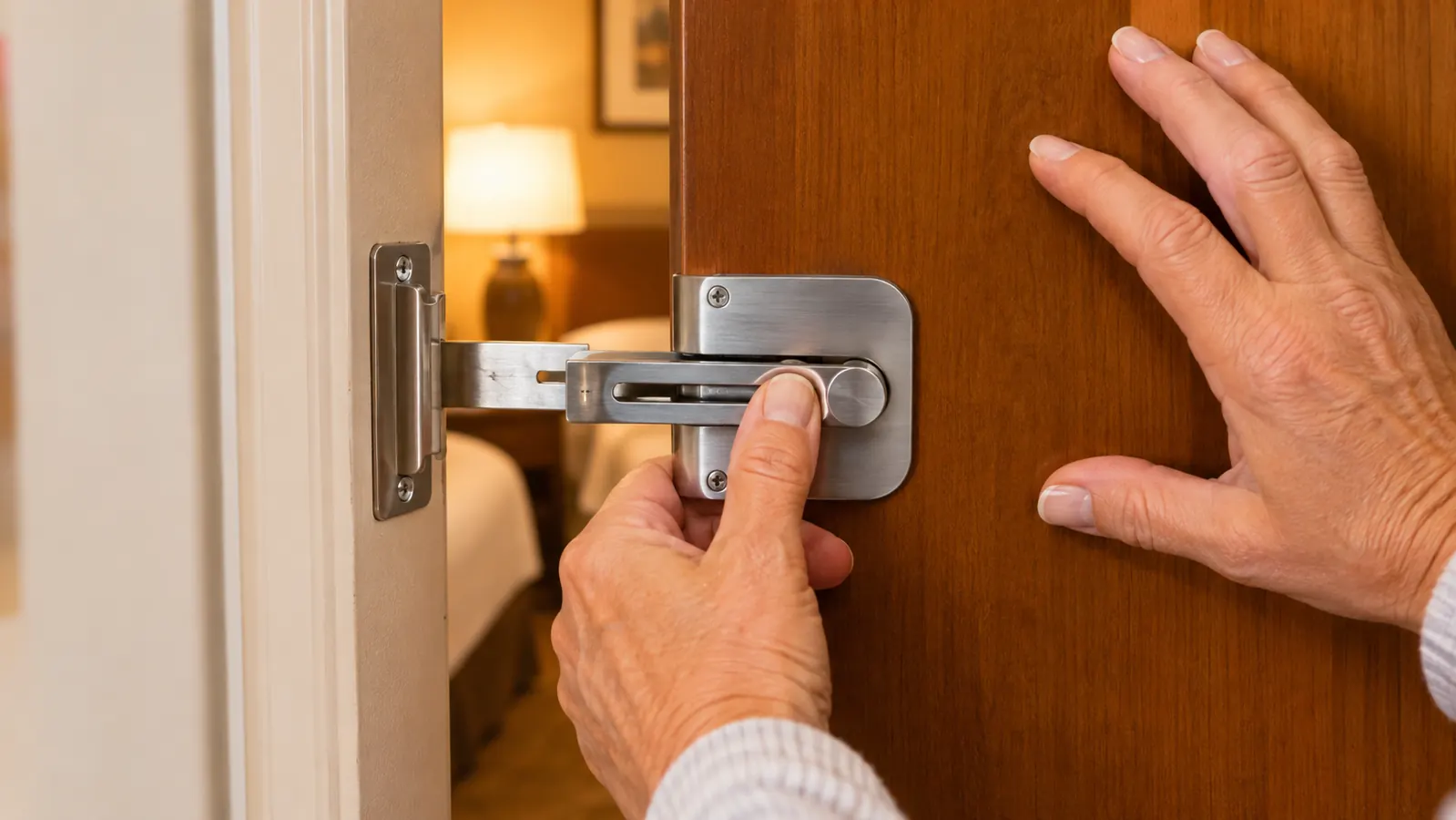
The first advantage is the plainest one. When the Addalock is in place, the door does not move. Not a crack, not a test wiggle. A door stop alarm has to allow the door to travel a little before it can sound, because nothing happens until the door presses on it. That is not a criticism of the alarm. It is simply what an alarm is. If what you want is a door that stays shut while you sleep, you want the lock.
The second advantage is that there is nothing to remember. The Addalock is one piece of stainless steel, 5.8 by 3.5 by 0.7 inches and 4.2 ounces, and it lives in a zip pocket of my carry-on. I take it out, fit it into the door latch, close the door on it, and try the handle once. No battery. No switch. No charging cable. In two and a half years it has not asked a single thing of me. Hotel room doors are almost always hinged doors that open inward, which is the kind this is made for, and I have not yet met one it would not fit.
Where a Door Stop Alarm Wins
Here is where I will give the alarm its due. If someone does get your door moving, you want to know it, and you want the hallway to know it too. A loud alarm does two jobs at once. It wakes you, and it gives a person standing at your door a reason to decide this is not a quiet room to be loitering outside of. My Addalock does neither. It holds, and it holds silently, and I will sleep straight through whatever it is doing.
The second honest point for the alarm is that it does not depend on the door hardware being in good shape. An alarm sits on the floor under the door. It does not care whether the strike plate is tight, whether the latch is worn, or whether the frame has been painted over so many times that nothing lines up anymore. If the hardware is what worries you about a particular room, a device that sits on the floor sidesteps the whole question.
The one that keeps the door shut, not just noisy
It is a single piece of stainless steel, 4.2 ounces, that fits into the door latch and holds. It has been in my carry-on for two and a half years of hotel nights, and it has never needed a battery.
Amazon Check Today's Price on Amazon →What a Door Stop Alarm Actually Is
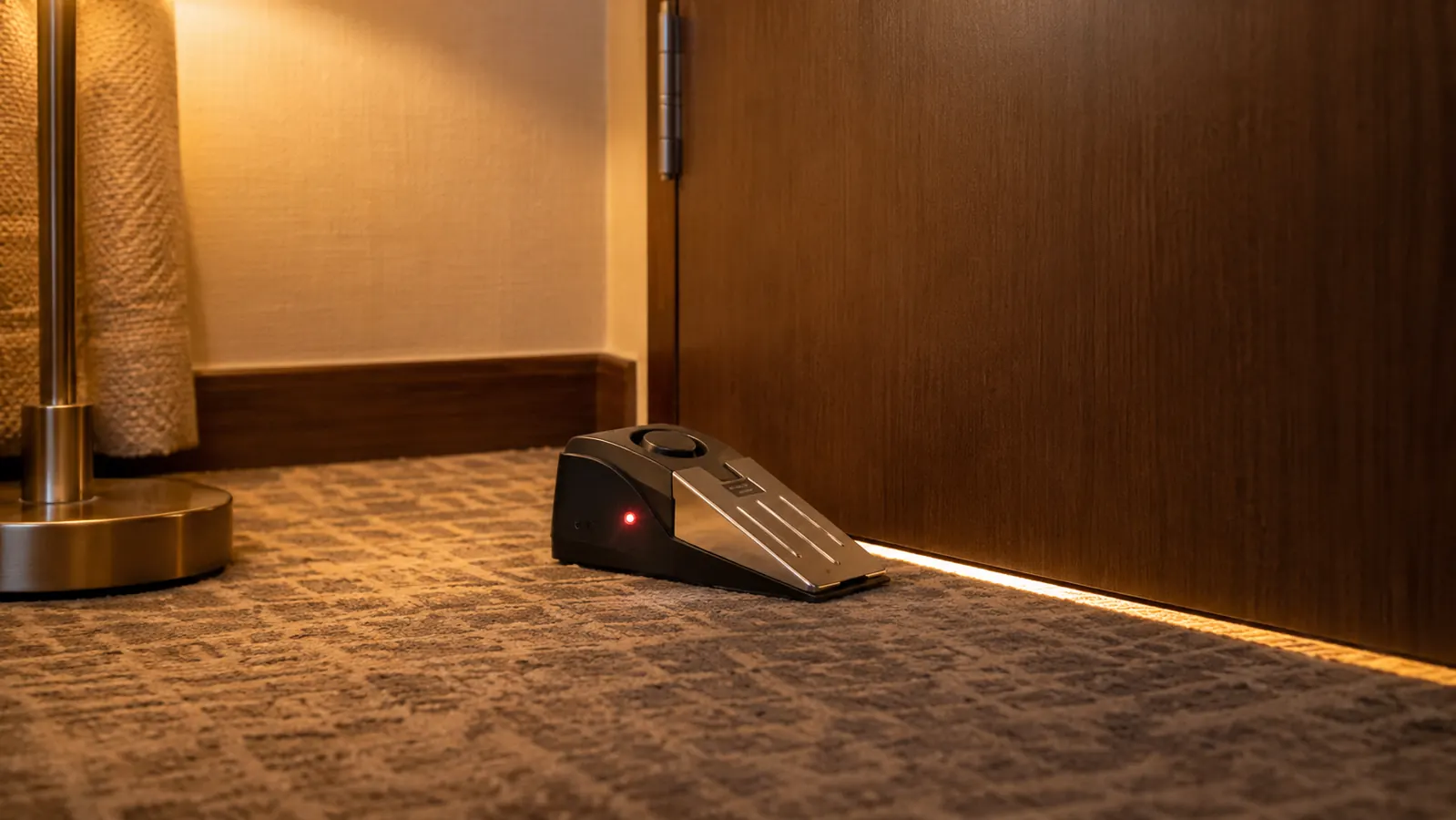
So we are clear about what I am comparing. A door stop alarm is a small floor device, shaped like the wedge you might kick under a dormitory door, with an alarm inside it. You set it on the carpet on the inside of your door, switch it on, and go to bed. If the door swings toward it, the pressure sets off the siren. Most of the ones I have looked at run on a battery, which means there is a battery in the equation and a switch that has to be in the right position.
I have never owned one, and I will say that plainly. Everything I know about them comes from reading listings and from twenty six years of listening to travelers describe their trips. The device I own and use is the Addalock.
If you are shopping for an alarm, the two things I would check in the listing are the floor gap and the battery. A stopper needs some clearance to slide under a hotel door, and hotel doors are not consistent about clearance. And a device that runs on a battery is only as good as the battery inside it. Neither of those is a reason to skip one. They are reasons to test it in your own hallway at home before you trust it in Lisbon.
What Two and a Half Years of Hotel Doors Taught Me
Two and a half years is roughly eight trips and somewhere north of thirty hotel nights, and the honest summary is that nothing has ever happened. No one has tried my door. No one has come into a room of mine who was not invited. The Addalock has never been the reason a night went wrong. I say that first because I do not want to sell anyone a frightening story. The reason I carry it is not that I have been through something. The reason is that a hotel room door is the one door in my life that a stranger also has a key to.
What I have learned is that hotel doors are less uniform than you would think. Some latch with a heavy click you feel in your hand. Some need a nudge. I once stayed in a room where the door had to be lifted slightly for the deadbolt to line up, and that night I was glad of a lock that did not depend on anything in the door being perfect. I do the same three things every time now. Deadbolt, then the Addalock, then the handle test. It takes less time than finding the light switch.
And I have learned where to keep it. It lives in the small zip pocket of my carry-on, the one that is not the liquids pocket, so I am not digging through a bag at midnight in a hallway. Walt keeps his own routine and his own bag, and when we travel together he checks the door after I do. I have decided that is thorough rather than insulting.
A lock keeps the door closed. An alarm tells you the door opened. You are the only one who knows which of those two nights you are trying to avoid.
What to Check Before You Buy Either One
For the Addalock, check the direction your door opens. It is made for doors that open inward into the room, which is what you will find in nearly every hotel. Measure nothing. It goes in a zip pocket and weighs 4.2 ounces, so there is no packing decision to make. The one thing to check when you first try it is that the door actually closes on it and the handle will not turn. Ten seconds in your own house before your trip will teach you the motion.
For a door stop alarm, check the floor gap under the door in the room you will be in, which you cannot always know in advance, and check the battery the way you check a smoke alarm. Also decide where it goes so that you are not stepping over it at two in the morning on the way to the bathroom. That last one sounds small and it is not.
The Thing Neither One Does
Neither device takes the place of the deadbolt the hotel already gave you. I use both, deadbolt first. And neither one takes the place of judgment: not opening the door to someone you did not call the desk about, and not saying your room number out loud in a lobby. Hardware is the last line, not the first.
One more thing that belongs in the fine print. Both of these need you to actually put them out. The Addalock does nothing sitting in a suitcase, and an alarm does nothing sitting in a suitcase either. The difference is that the Addalock takes about four seconds and no thought, so I do it even on the nights I land late and the room is warm and I am too tired to be careful. Four seconds is about all I have in me by then.
Who Should Buy Which
Buy the Addalock if the thing you want is a door that stays closed. That covers older travelers on their own, anyone who has lain awake listening to a hallway, and anyone who would rather prevent a problem than be woken by one. It is also the better pick for a heavy sleeper, because an alarm is not much use to a person who sleeps through alarms. Mine has been in my bag for two and a half years, and if I lost it tomorrow I would order another the same day.
Buy the door stop alarm if what you want is warning. If you sleep lightly, if you are traveling with a companion and want a second set of ears, or if older door hardware worries you more than the door itself, then the noise is the point and the noise is what you are choosing. Some travelers pack one of each, lock on the door and alarm on the floor, and I cannot argue with that at all.
Whichever you choose, buy it before the trip and use it at home once. A device you have never handled in your own hallway is a device you will fumble with at midnight in a strange city, and fumbling is how things get left behind in hotel rooms.
If you want the door to stay shut, this is the one I pack
One piece, 4.2 ounces, nothing to charge and nothing to switch on. It fits into the door latch and holds. Two and a half years of hotel nights so far.
Amazon Check Today's Price on Amazon →