
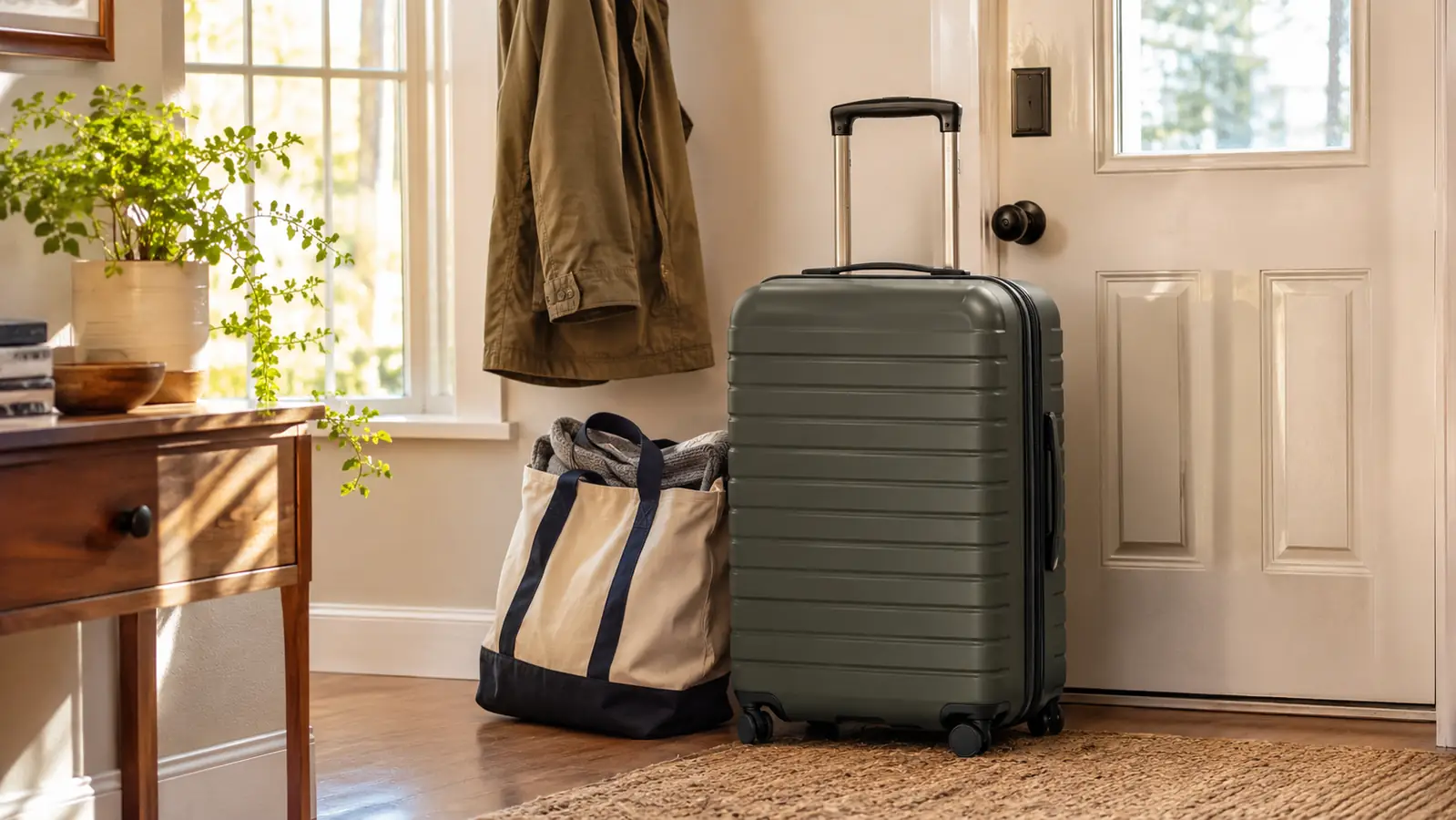
I bought the Samsonite Omni 20-inch carry-on about two years ago, a few weeks before a spring trip to Portugal, and I have taken it on roughly eight trips since. This is not a first-impression piece. First impressions are cheap and they are usually wrong. What I want to tell you is what the bag is like in year two, on a wet Tuesday in a small hotel with no lift, when both halves are full, the flight has already been delayed twice, and you are sixty-three years old and tired and the stairs are narrow.
Here is the short version, and then I will walk through the rest. The shell has held up. The wheels have not once given me trouble. Nothing has been lost and nothing has broken, and the only damage on the whole bag is a set of scuffs on the corners that I can point to but you would not notice unless I did. What nobody told me is that this bag weighs 6.1 pounds before I put a single thing in it, and that six pounds stops being a number and starts being a decision when you are the one carrying it up a flight of stairs.
The Quick Verdict
A genuinely tough carry-on that has taken eight trips of baggage handling without a complaint worth making. It is heavier empty than you would guess, and the two rigid halves ask for more floor space than a softside bag ever did.
Amazon Check Today's Price →Eight trips in and the wheels still roll straight
The Samsonite Omni is the carry-on I keep reaching for, and the 10-year warranty is the reason I stopped shopping. Check the current listing for sizes, dimensions and today's price before you decide.
Amazon Check Today's Price on Amazon →How I've Used It, and What That Actually Tests
I have been a travel agent for twenty-six years, part time now, and I pack my own bag about four times a year. One or two of those trips are international, mostly Europe, and two or three are domestic and by plane. Walt and I check nothing. On a trip of two or three nights we share this one bag and each carry a tote. On anything longer we bring a carry-on apiece, which is why the weight of the empty bag matters so much to me now. It did not matter at all ten years ago.
Before the Samsonite I had a two-wheel softside roller from around 2009. The wheel housing cracked and I retired it. Walt still uses his own older softside roller, so I have both kinds in the house and I can set them side by side without guessing. That is the honest version of how I know what a hardside does differently. I am not comparing catalogs. I am comparing two bags in a hallway.
Every trip follows the same routine. I set the bag on the bed, open it flat, and pack from the hinge outward. I check that the TSA lock is fastened before I leave the house, because at the airport I am distracted and I will not remember. Then it goes in the trunk, then on the plane, then into the overhead bin, which it fits with room to spare on the domestic carriers I fly.
The domestic trips test it in a quieter way. Two nights with Walt, one bag between us, and everything has to earn its place. That has made me a better packer. I lay things out on the bed, I look at them, and I put a third of them back. That is not a feature of the bag. It is what the bag taught me, and I will take it.
What Nobody Tells You: It Weighs 6.1 Pounds Empty
The listing says 6.1 pounds, and I read that number when I bought it and thought nothing of it. Six pounds sounds like air. It is not air. It is the price of admission, paid before you pack a single sock, and on a bag this size you feel it. The packing space inside measures 19 by 14.5 by 9.5 inches, and the outside measures 22 by 15 by 9.5. That is a sensible amount of room. It is not a suitcase you can fill with bricks.
Where it bit me was Portugal. The hotel was lovely and the lift was out, or there was no lift, I cannot remember which, and I carried the bag up two narrow flights holding the top handle with both hands. I made it. I also stood at the top and had a quiet word with myself about how I pack. A lighter bag would not have solved it entirely, but a lighter bag would have helped, and there is no way around saying so.
There is a second cost to the weight and it is quieter. When the empty bag is heavy, you pack fewer clothes, and then on the way home you have less room for the things you bought. I mailed a package home from Italy once. I am not proud of it, but there it is, and no amount of clever folding would have changed it.
So here is the advice I give clients now, and it applies double to anyone over sixty. Before you buy any hardside carry-on, lift it in the store with nothing in it. Or fill a laundry basket with six pounds of towels and carry that up the stairs. It sounds silly. It takes four minutes and it will tell you more than any review, including this one. The trade is real, though. A shell that does not tear is a shell that does not flex, and the bags that weigh less are usually made of something softer.
The Two Halves Open Flat, and That Changes How You Pack
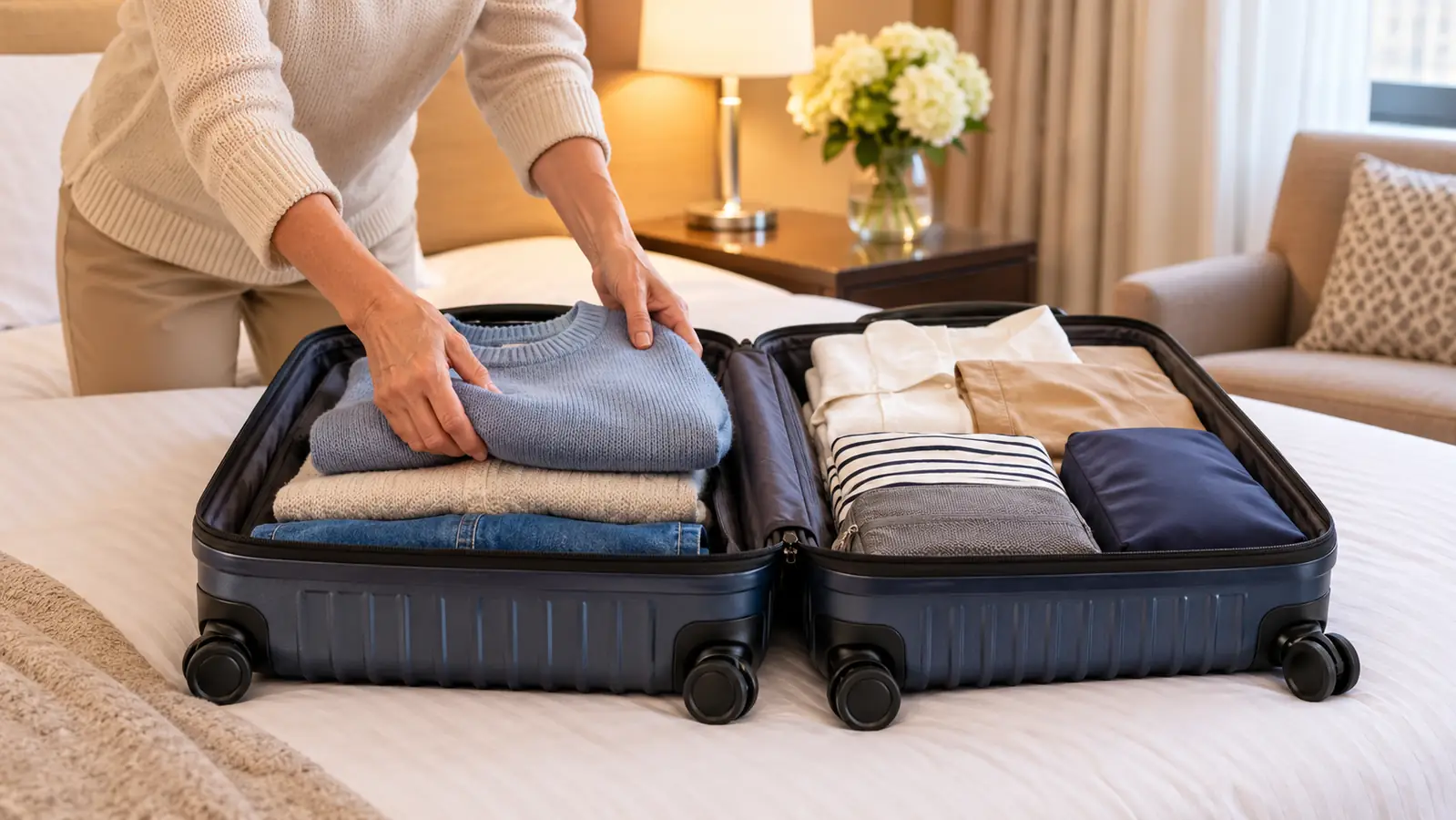
The bag is two sections and it opens like a book on a hinge. This is not a fault. It is a decision with consequences that nobody prints on the tag. The first consequence is that you need a bed or a floor to open it. You cannot hold it half open on your lap in a cramped airport bathroom. The second is that a rigid half does not let you shove. With a softside you can lean on it and the fabric gives. With this, you fold, you stack, and you close it.
I have come to prefer it, and here is why. When the bag is open flat, everything is visible at once. I do not dig. I do not lose a belt in a dark corner. The stretchable strap on one side holds a stack of folded clothes down, and the other side takes the flat things. On the way home, if security has opened the bag for inspection, I can usually tell from how the two halves are lying. That is worth something to me at my age in a way it would not have been at thirty.
I roll my clothes and I use packing cubes, and the cubes are what make the two-half design work in practice. Without them the layers shift the moment the bag stands up. With them, everything arrives where I put it, and I can pull one cube out at a hotel without unpacking the rest. If you buy this bag and keep stuffing it loose, you will blame the bag for something the cubes would have fixed.
What I gave up is the outside pocket. There is not one, and you cannot reach a paperback or a boarding pass without opening the whole bag. Walt's softside has a front pocket and he uses it constantly. My workaround is a tote on my shoulder that holds the book, the paperwork, the glasses and a cardigan. It works. It is not the same as a pocket.
The only damage on the whole bag is a set of scuffs on the corners. Eight trips, and that is the entire complaint the shell has earned.
What Has Held Up, and What Has Not
The shell is the micro-diamond polycarbonate the listing makes a point of, and the texture is not decoration. A smooth shell shows every mark. This one breaks up the light enough that a scuff has to be pointed out. The corners are where mine has taken it, mostly on the wheel side, and those scuffs sit a shade lighter than the rest of the shell. They have not deepened or spread. I have not covered them and I would not.
The four spinner wheels have been the surprise. I expected them to be the first thing to go, because with my old bag they were. They have rolled straight on tile, on airport carpet, on a cobblestone street in the Algarve where everything rattled, and across a wet parking lot in Wisconsin. The slotted wheel design sheds grit instead of holding it, which may be why. I have not had to cut hair or thread out of an axle once, and with the softside I did that every year.
The telescopic handle has a small amount of give when it is fully extended and the bag is heavy. I noticed it in year one and I still notice it. It has not gotten worse and it has not failed. Everything else, the zippers, the expansion, the lock, has done what it was supposed to do. I used the expansion once on a return trip and it bought me room for two gifts and a jar of something local. I would not fly with it expanded. I would use it in the car.
What I Liked
- Micro-diamond polycarbonate shell has taken eight trips of baggage handling and shows only surface scuffs on the corners
- Four spinner wheels have rolled straight on tile, carpet and cobblestone with no wobble and no hair in the axles
- Opens flat into two sections, so you can see everything at once instead of digging
- Built-in TSA lock lets security open the bag without cutting it
- 10-year warranty against defects in materials and workmanship
- Expansion adds room on the return leg for gifts
Where It Falls Short
- 6.1 pounds empty, before you pack a single thing
- Two rigid halves need floor or bed space to open, which is awkward in a cramped room
- No exterior pocket, so nothing is reachable without opening the bag
- The shell does not flex, so overpackers will lose this argument every time

What I Considered Instead
I looked at softside again before I bought this, and I still walk past them in stores. A softside roller has the front pocket, it flexes when you need it to, and Walt's has survived a decade of his own packing. What moved me was the wheel housing on my old one. It cracked. A shell does not crack the way a fabric-and-frame bag does, and the micro-diamond texture hides the marks that a woven fabric would keep. That was the whole argument, and two years later I still think it was the right one for the way I travel. The Samsonite was the bag I kept coming back to.
I also looked at lighter hardside bags, because by then I had already noticed my shoulder. The ones that weigh less are usually thinner, and they flex in the middle when you press on them. I did not want a bag that flexes. What I wanted, and what I got, was a bag I do not have to think about. If I were ten years older, or if Walt and I were flying more than four times a year, I might trade two pounds for a front pocket and be happier. Different traveler, different bag.
The Fine Print Is Worth Reading
The bag carries a 10-year warranty against defects in materials and workmanship. Read that sentence twice, because the words are doing the work. It covers how the bag was made. It does not cover what an airline does to it, and it does not cover scuffs or ordinary wear, which is why I am not expecting anyone to repaint my corners. Keep the receipt. If you buy it as a gift, keep the receipt yourself. I have watched clients learn that lesson the hard way with other brands.
The TSA lock is the other piece of fine print. It is a lock the screeners can open without cutting the bag, which is the entire point of it. It is not a safe and I would not treat it like one. Passports and the backup card ride in a neck wallet under my shirt on travel days, and the bag holds clothes. That is the division of labor in our house, and it has not changed in twenty-six years of sending other people places.
One more line from the label that is easy to skip. The 20-inch is described as meeting most carry-on restrictions for domestic travel. Most is the word to hold on to. If you are flying a carrier with tighter cabin limits, measure the bag against their published numbers before you go, because the outside of this one is 22 by 15 by 9.5 and the allowances are not the same everywhere. A travel agent ought to tell you that. A review ought to as well.
Who This Is For
This bag is for the traveler who unpacks at the hotel instead of living out of a suitcase for a week. It is for someone who would rather have a shell that does not tear than a bag that squeezes down another inch. It suits domestic flying, where the 20-inch fits without an argument, and it suits the person who carries a tote for the things they want during the flight. If you can lift six pounds plus your clothes overhead, and you are honest enough with yourself to pack light, it is a very good bag. Two years in, I would buy it again.
Who Should Skip It
Skip it if you are a stuffer. The shell will not flex and the two halves will not forgive you. Skip it if you fly carriers that weigh cabin bags at the gate, because 6.1 pounds counts against you before your clothes do. Skip it if lifting a bag overhead or carrying one up stairs has become a thing your body complains about, since the empty weight is the part you cannot negotiate. And skip it if you want a front pocket for a book and a boarding pass, because there is not one. None of those are flaws in the bag. They are the bag being what it is, and it is better to know that now than at the top of a stairwell.
Two years, eight trips, and I would still buy it
If the empty weight works for you, the Samsonite Omni is the last carry-on you will shop for in a while. The listing has the exact dimensions, the 10-year warranty and the current price.
Amazon Check Today's Price on Amazon →