
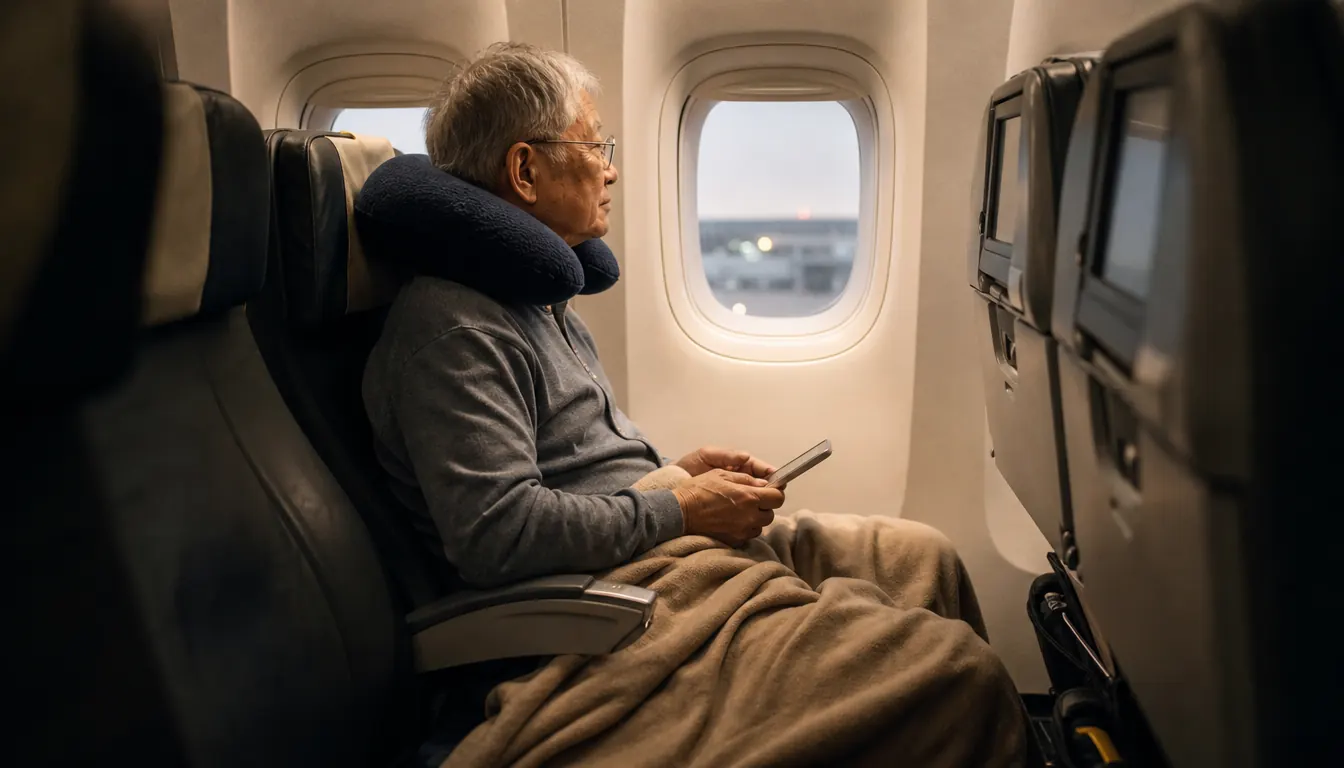
Twenty-six years as a travel agent and I still did the same foolish thing on every flight. I rolled my cardigan into a tube, wedged it between my ear and the window, and woke up somewhere over the Atlantic with a neck that turned only halfway for three days. Eighteen months ago, before a long flight to Ireland, I finally bought a napfun memory foam neck pillow. It lives in my carry-on now. It has flown everywhere with me since, and Walt still refuses one, which tells you something about husbands and something about how stubborn a man can be about a small bag.
This is not a list of specs for their own sake. It is the ten things that actually made a difference to me, in roughly the order I noticed them, written for the traveler who takes a few trips a year, carries on and checks nothing, and has a neck that has begun to complain about the whole business of flying. I am 63. I am not trying to sleep like a teenager in seat 34B. I am trying to land in Dublin able to lift my own suitcase off the belt.
The pillow I stopped noticing by hour two
Memory foam that softens with your own body heat, a semicircular shape, 10.88 ounces on the listing, and a bag it compresses into. It has flown with me on every trip since Ireland.
Amazon Check Today's Price on Amazon →The foam softens against your neck instead of pushing back
Memory foam uses your own body heat to contour and adapt, and that is exactly what happens. You set the pillow where you want it, lean back, and after a minute or two it has taken the shape of your jaw and the side of your neck instead of staying a stiff ring you have to fight. On the flight to Ireland I noticed it around hour two, which is to say I stopped noticing it at all. For a piece of travel gear, that is the whole test.
At 10.88 ounces it does not count against your shoulder
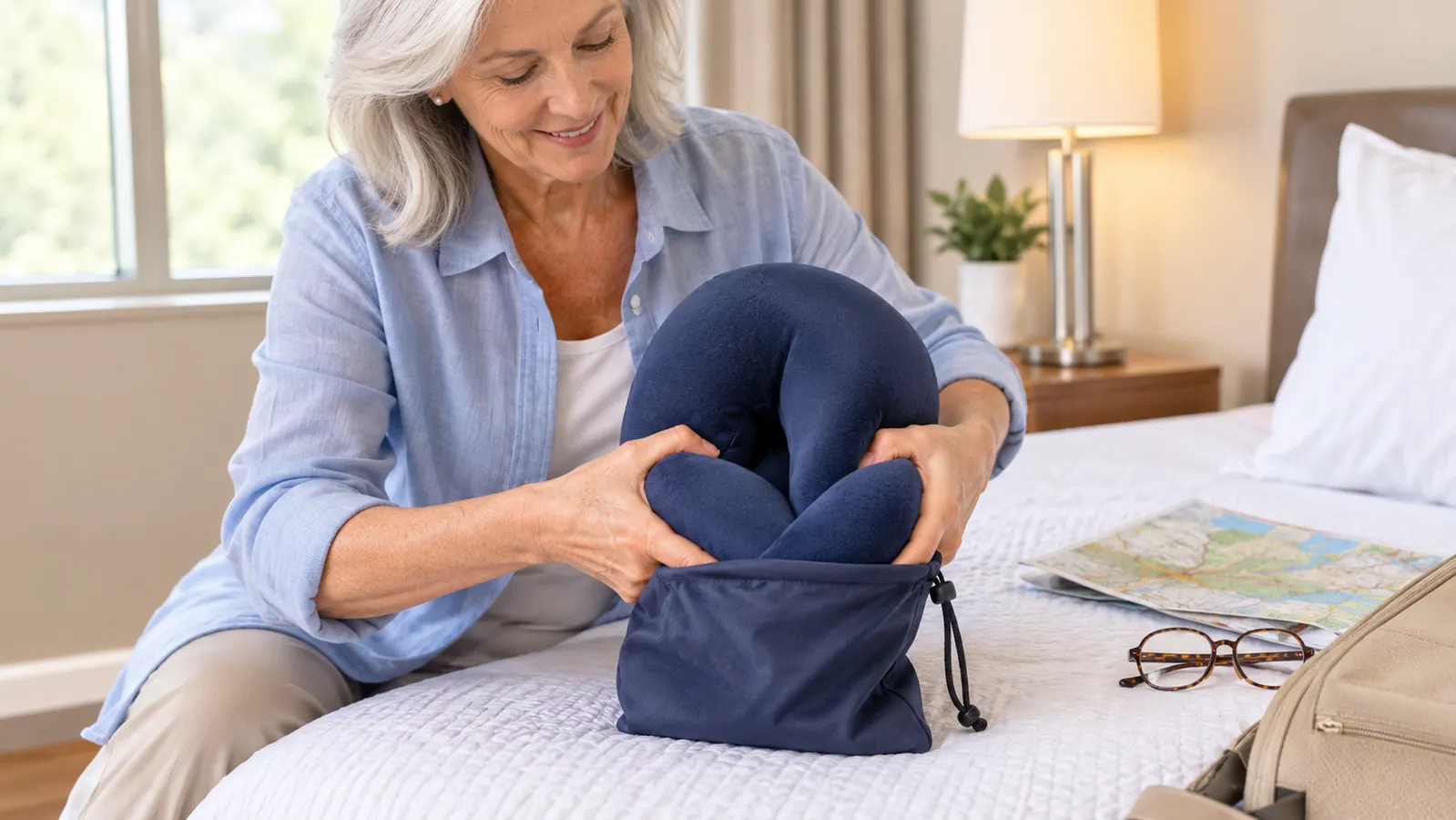
I have a trick shoulder from too many years hauling sample bags through terminals, and I notice weight. The napfun pillow is listed at 10.88 ounces. That is about the weight of a paperback. It rides in my tote beside the passport wallet and a folded scarf, and I do not feel it until I want it. If you are packing a personal item to the limit, and most of my clients are, that number is the one worth writing down before you buy anything.
The semicircular shape catches your head when it drifts sideways
The shape is listed as semicircular, and that is precisely the job it does. It cradles the back and sides of the neck, so when your head starts to roll toward the window or the aisle, there is something there before your ear meets the seat frame. I used to wake myself up with that little head-drop, the one where your chin goes down and you jolt. I have not done it once since Ireland. Small mercy, but the kind you feel on arrival day.
It presses down into its own bag and disappears in your tote
It comes with a portable travel bag, and the pillow compresses down small enough to go inside it. I press it in, close the top, and it drops into the front pocket of my Samsonite or the bottom of my tote. That is the part I did not expect to care about. A pillow that will not pack is a pillow you leave at home, and I have left plenty of things at home over the years, usually in a hurry, usually on the kitchen counter.
You can put it in the machine, and after a long trip you will want to
The care instructions say machine wash. I wash mine the day I get home, the same afternoon I unpack, and it comes out smelling like my own laundry instead of like an airplane. I read that line on the listing twice before I bought it, because a travel pillow you cannot clean is a travel pillow with a short life, and I have thrown out enough things that could not be washed to know better by now.
Soft firmness, so it does not dig into your jaw on a long haul
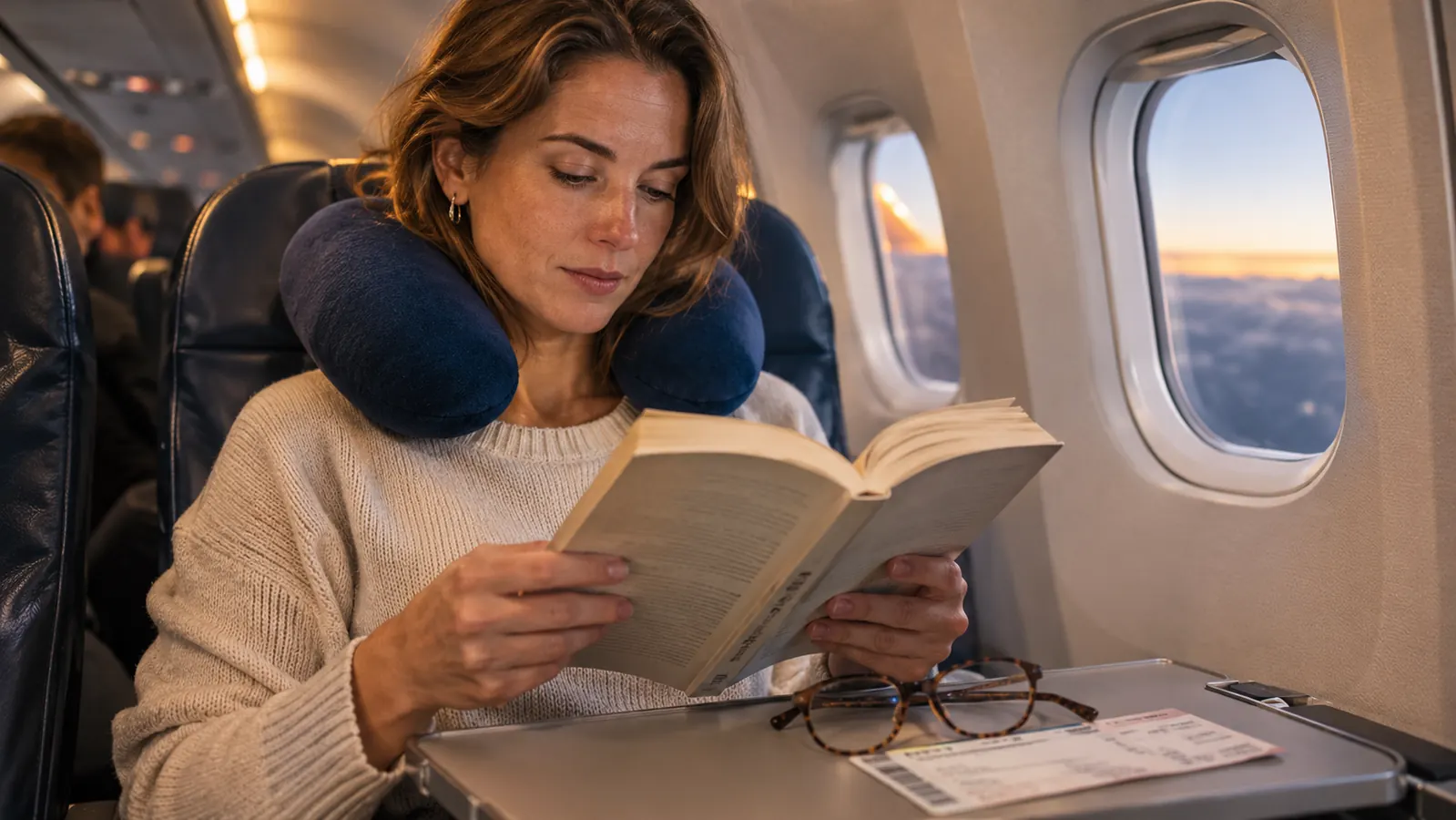
The firmness description is soft, and soft is what I wanted. Years ago I borrowed a pillow that felt like a rolled yoga mat and it left a red mark along my jaw that lasted through customs. This one gives a little. On a six-hour flight I can turn my head, look out the window, say something to Walt, and it moves with me rather than holding me in one position like a brace. That makes it useful for the whole flight, not just the sleeping part.
Cooling fabric matters when the cabin never quite cools down
Cooling is one of the four features on the listing, alongside portable, adjustable and compressible. I did not think much of it until a July flight when the cabin never got comfortable and the man beside me was fanning himself with a magazine. The back of my neck stayed dry through that one. If you run warm, or you are of an age where the thermostat has become a personal matter, this is the detail I would check before anything else on the page.
It works sitting up with a book, not only for sleeping
The recommended uses are sitting and sleeping, and I have used it for both. Plenty of flights I do not sleep at all. I read, or I go back over the next day's itinerary and the address of the hotel, and the pillow sits behind my neck like a cushion against the seat back. Walt teases me about the whole arrangement. He also falls asleep on my shoulder by hour three, so I let him tease and I keep the pillow.
A middle seat stops being the worst seat on the plane
Nobody wants the middle, and I have sat in plenty of them. What makes the middle hard is that you cannot lean either way without leaning on a stranger or on the armrest, and that is where a pillow earns its keep. You sit upright, supported, not tipping into the shoulder of a person you will never see again. I have booked a great many seats for other people. I still get the middle on a full flight, and now I mind it less.
It is one less thing to think about on the morning you fly
I plan trips for a living and I still get up at an unkind hour on travel day. The night before, I put the napfun pillow in its bag, put the bag in the carry-on, and say a short prayer about the connection in Chicago. Having the small things already settled means the morning is quiet, and quiet mornings are worth more to me at 63 than they were at 45. That may be the plainest reason on this list, and it is the one I would keep.
What I'd Skip
Skip the inflatable kind if you can. I have never owned one, but I have listened to clients describe blowing one up in a dark cabin, losing half the air by hour three, and hearing the valve squeak every time they moved their chin. I would also skip buying two of these. One lives in my carry-on and stays there, and I have not once wished for a spare. And I would skip the last-gate kiosk version, because you will pay for forgetting yours and you will not have read a single line about what is inside it. Read the listing, then buy the one you actually want, then leave it in the bag so it is always where you expect.
I used to wake myself up with the head-drop, that jolt where your chin goes down. I have not done it once since Ireland.
One honest note. This is a travel pillow, not a cure. It will not fix a bad seat, and it will not make a red-eye feel short. What it does is keep your neck in a position your body does not argue with for six or seven hours, and it packs small enough that you never have to decide whether it comes along. For me that has been enough to make it the one piece of comfort gear I replace without thinking if it ever wears out.
Small bag, long flight, one less ache on arrival
Pure memory foam, semicircular, 10.88 ounces, machine washable, and it compresses into the travel bag that comes with it. Mine has been in the carry-on for eighteen months and roughly a dozen flights.
Amazon Check Today's Price on Amazon →